
Journal · Design ·
2027 Rug Trends: What Designers Want, Explained by the People Who Weave Them.
The 2027 interior reads differently from the quiet, all-beige rooms that dominated the last two years. Buyers we quote for are asking for colour that holds its own, pattern that returns without apology, and texture you can feel from across the room. This is a view of the seven trends shaping bespoke rug briefs this year, with a factory note under each one explaining what the trend actually asks a loom to do — and what a designer should write into the specification before the first lab dip is pulled.
The seven directions buyers are asking for in 2027
These are the briefs we are receiving from designers, hotel procurement teams and private-label brands in late 2026 for 2027 delivery. None are entirely new; several echo materials and patterns that walked the carpet floor fifty or a hundred years ago. What is new is the confidence with which buyers are asking for them. Beige has done its work. The next room is colour, texture and craft.
1. The end of plain beige

The "quiet luxury" beige of 2024 and 2025 flattened the floor to a background. In 2027 the floor comes forward again — not loud, but grounded. Buyers are asking for pigments with depth: rust, aubergine, deep ochre, forest, ink. The point is not to shout; it is to let the rug anchor the room so the furniture can breathe.
How it is made
Grounded colour reads best where dye depth can show. In hand-knotted wool the knot is both pigment carrier and light surface — density matters less here than the wool grade and the dye recipe. A long-staple RWS wool at 2200–2800 GSM in hand-tufted will hold a deep pigment without turning muddy; the same pigment in a short-staple blend lifts to a pastel in six months. Specify long-staple wool, Pantone TPX or TCX or ARS 1400 for the colour reference, and sign the physical lab dip under D65 light — not a monitor — before pulling into bulk.
2. Heritage prints: Oushak, Persian-painterly, faded florals

The decorative pendulum has swung back towards ornamented, traditional pattern — but softened. Buyers are asking for Oushak and Persian compositions in washed-out palettes: dusty rose, faded indigo, sage, oatmeal. The reference is often an antique-shop find rather than a current catalogue. The rug should look like it has been in the room for forty years, even if we finished it last month.
How it is made
Hand-knotted in wool at 60–100 KPSI is the honest construction for painterly pattern. Below 60 KPSI the detail collapses; above 100 you are paying for density the composition does not need. We hand-knot on cotton foundation, in long-staple wool, with the soft palette matched at lab dip and the faded quality developed at the wash yard — a chemical-free wash with careful shearing to settle the pile. Lead time: about 60–80 days of loom at 60–100 KPSI, plus the 15-day CAD and 10-day lab-dip arcs that run alongside. Designer spec: construction, KPSI band, wool grade, Pantone references for every colourway, and a knot map reference for how the painterly transitions should be interpreted on the grid. For a deeper view of the construction, see hand-knotted rugs.
3. Small-scale florals, checks and stripes
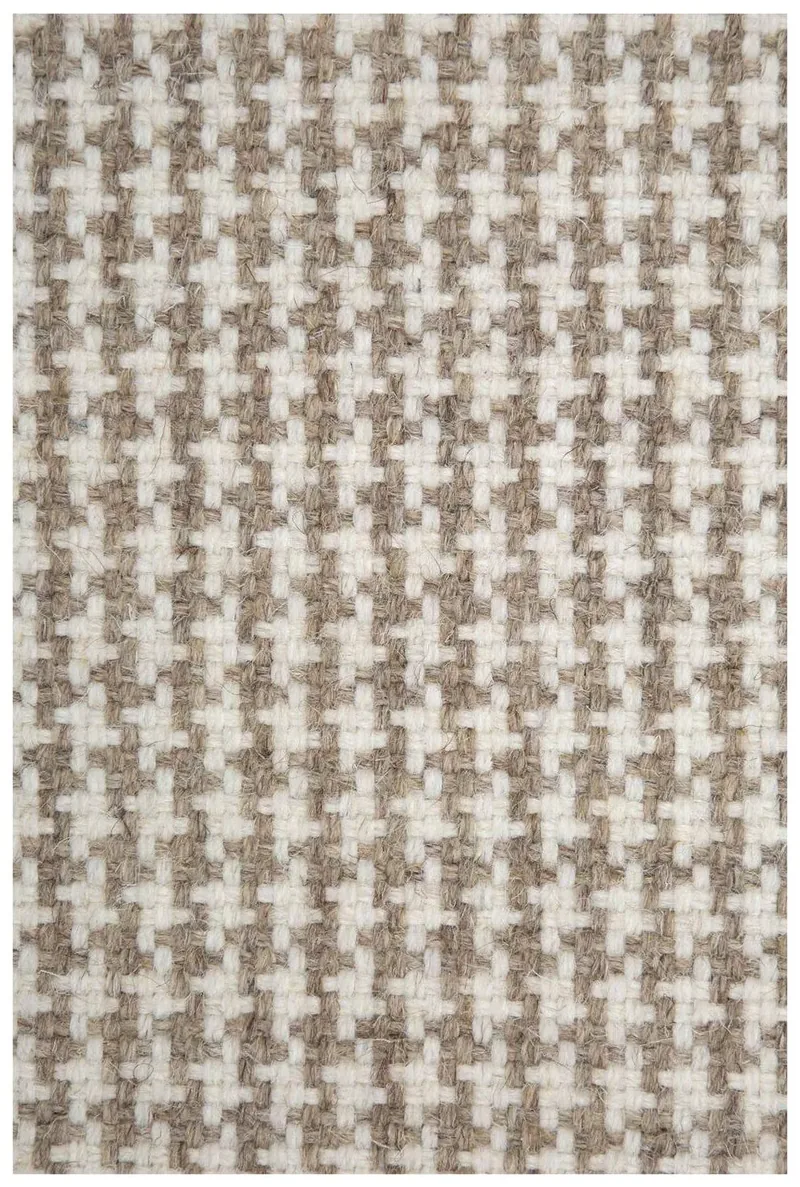
Alongside heritage, there is a parallel return to the "wallpaper floor": small-scale repeats — ditzy florals, narrow stripes, fine checks, houndstooth. These sit politely under furniture, read as texture from standing height, and reveal their pattern when a visitor sits down. The scale is important. These are not overscaled geometrics; the motif height is typically 2–5 cm.
How it is made
Fine pattern needs either knot resolution or weave density. For florals, hand-knotted at 60–80 KPSI in wool resolves cleanly. For checks and stripes, flatweave is the honest construction: the structure itself is the pattern. For houndstooth and fine geometrics you can also hand-tuft, but specify 2500–3000 GSM and a short pile (8–10 mm) so the pattern does not wash out. Lead time: 35 days for flatweave; 45–60 days for a KPSI-banded hand-knotted; 35–45 for hand-tufted. Spec the motif height in millimetres on the brief — this is the single variable most often left ambiguous. See kilim and flatweave for stripe and check construction detail.
4. Mixed textures and high-low pile
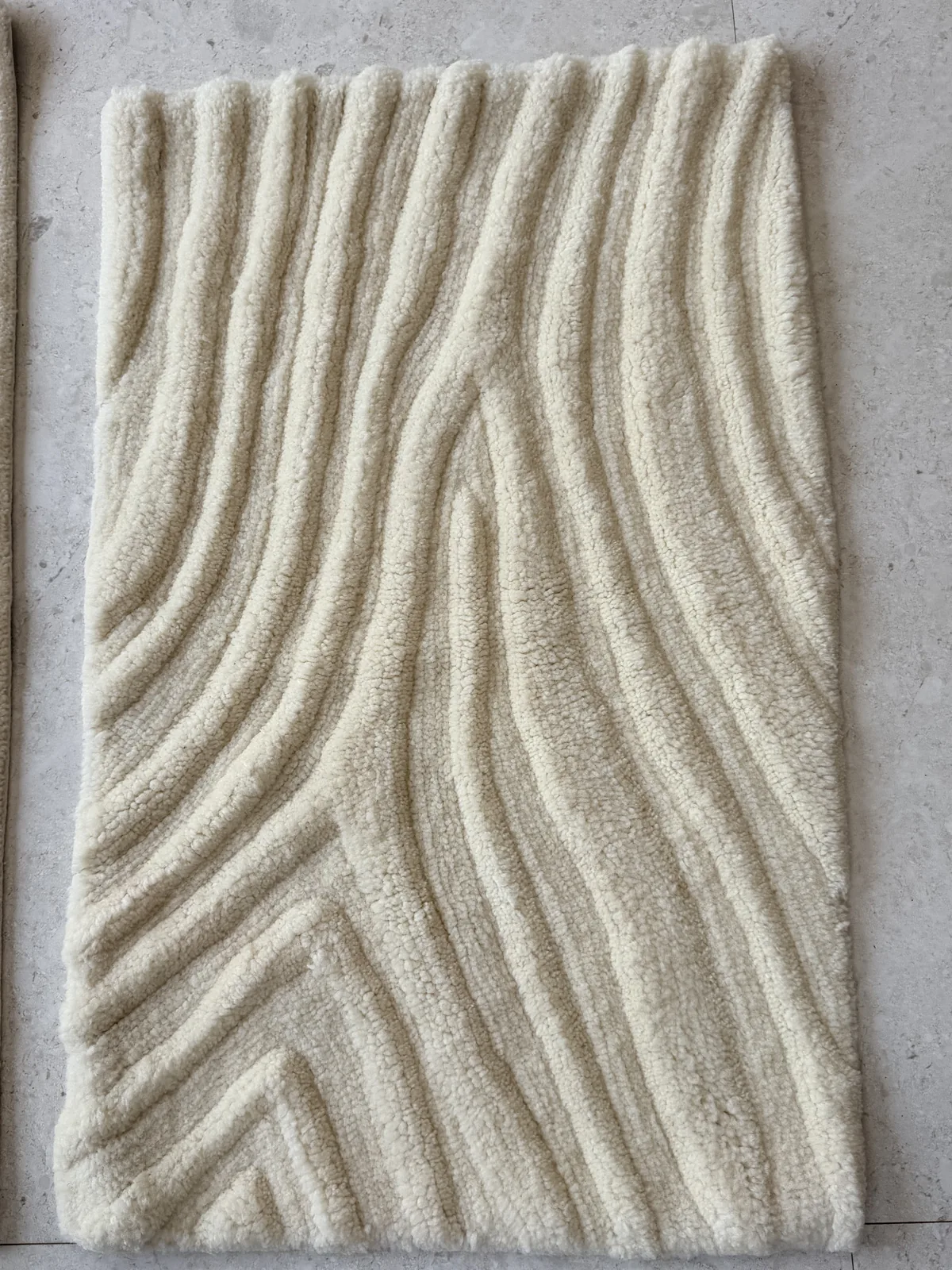
Where plain beige rooms relied on wall and furniture for tactile interest, 2027 wants the rug to do more of the work. High-low pile, carved relief, and multi-texture surfaces (a cut loop next to a flat loop next to a soumak detail) are showing up in hospitality and private-residence briefs. The effect is quiet from above and compelling underfoot.
How it is made
Carved hand-tufted is the native construction. The design is drawn onto the primary canvas as both pattern and relief map; the pile is tufted to the higher of the two heights, then carved by hand with long-blade shears to the low areas. Every carved edge at PiHue is cut by hand. Specify the two pile heights (typical: 8 mm low, 18 mm high), the carving line width (fine < 3 mm, bold > 6 mm), and whether you want the relief "sharp" (straight-edge carved walls) or "sculpted" (shaped sides). Lead time: 45–60 days for a standard carved tufted programme. See carving and shearing for the technique.
5. Round rugs and shaped pieces
The rectangle is no longer a given. Round rugs are defining breakfast nooks, workspace break-out zones and bedroom reading corners. Oval, oblong, half-moon, irregular organic shapes — any closed CAD shape is a buildable rug. In hospitality the round is often doing the job of a terrazzo medallion, at a fraction of the installation cost and weight.
How it is made
Any construction can be made round, but hand-knotted and hand-tufted hold the shape most cleanly. The CAD stage is where the shape is set — the full-size design is traced on the loom frame or primary canvas, and the warp is set to the longest dimension. Edge binding on a round rug is hand-sewn, which adds about a week to finishing. For a round over 4 m diameter, specify the construction carefully; see our note on loom width and seams for when a round needs to be sectioned. Spec the shape by sending a scaled CAD or a dimensioned drawing, not a verbal description.
6. Statement borders
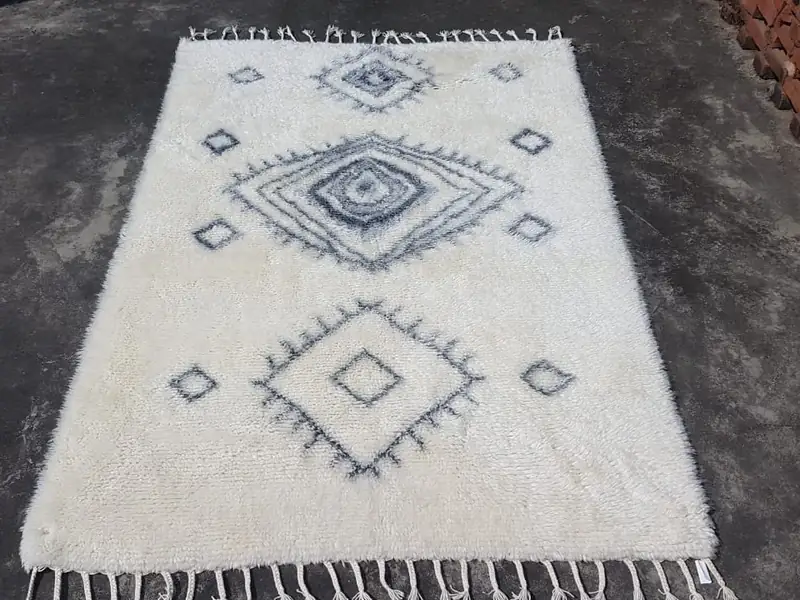
Bordered compositions are back — and not shy about it. Contrast borders in a deeper or lighter tone than the field, often with a secondary inner guard, are framing rugs as deliberate objects rather than background wash. The bordered rug reads particularly well in rooms where the furniture sits "inside" it — dining tables, lounge groupings — because the frame draws the eye to the perimeter of the composition.
How it is made
The border is a specification problem before it is a weaving one. It should be drawn into the CAD at full size; its width should be derived from the rug's finished size (a common rule: the border width is the rug's shortest dimension divided by about 10, so a 2 m-wide rug carries a 20 cm border). The border colour is specified separately at lab dip. On hand-knotted rugs the border reads crispest because the knot delineates the colour change; on hand-tufted the border should be at least 10 cm to hold a clean edge. Do not try to read a scaled drawing's border width off a photograph — always convert to millimetres on the brief.
7. Sage greens and the Webster Green moment

Benjamin Moore named Webster Green HC-130 — a sage, mid-value green with a soft grey undertone — its Colour of the Year 2027. The colour sits firmly in the muted heritage-green family that has been building across paint and interior palettes through 2026, alongside pale olives, eucalyptus, grey-greens and the archival sages of Benjamin Moore's Classics collection (October Mist, High Park and the like). These are not bold statement greens; they are quiet, restrained, archival. Designers are asking for them because they pair with wood tones, brass fittings, cream linens, and the painterly heritage palettes returning alongside them.
How it is made
Dye depth matters even on a soft green. A short-staple wool or a weak dye recipe reads khaki or grey where you asked for sage. We lab-dip greens against the paint chip or Pantone reference in long-staple wool first; if a monitor rendering suggests "sage" but the physical lab dip reads "olive" or "mint" under D65 light, we flag it before you approve. For custom paint matches (Webster Green HC-130, Benjamin Moore October Mist 1495, Farrow & Ball Pigeon, and the similar muted-green family), send the paint chip or Pantone equivalent and we return a dyed-yarn match in about ten days. See our colour library of 2,400 shades and the Pantone matcher for a starting point.
What a 2027 bespoke brief looks like on the pro-forma
The best 2027 briefs we receive carry five decisions in explicit numbers, before the lab-dip window opens:
- Construction. Hand-knotted (and KPSI band), hand-tufted (and GSM band), handloom, flatweave, or carved tufted.
- Fibre. Wool grade (RWS long-staple is the honest default), silk, viscose or blend. Fibre decides how deep the colour will read.
- Pile height and carving. Low (8–10 mm), medium (12–14 mm), high (16–18 mm), or high-low with the differential specified.
- Palette. Pantone TPX, Pantone TCX, ARS 1400 or a paint chip per colourway. Not a photograph.
- Finished size and shape. Rectangle, round, or custom CAD. Include the shortest dimension for border scaling.
Everything else — the border width, the carving line, the finish — derives from these five. Our quotation returns within hours of a brief this clean, and the ninety-day arc from CAD approval to dispatch holds the rest. For how that arc works in practice, see ninety days, stage by stage.
The 2027 thread
Reading these seven directions together, one pattern emerges: rooms are inviting the floor back into the conversation. For two years the brief was "make it disappear". For 2027 the brief is "make it earn its place". That is a brief we are built for. For more on the human side of that work — weaving, abrash, the quiet signs of a hand-made object — see why a hand-knotted rug is the most human object in your home.
Related reading on this site
On construction and lead time trade-offs: construction comparison. On what to send at the brief stage: sending artwork. On MOQ, lead time and freight: MOQ, lead times, shipping. On the testing that catches a wrong GSM before a rug ships: testing.
Ready to brief a 2027 rug?
Send a CAD, a photograph of the room, a Pantone reference, or a sketch. We quote same working day. MOQ is one piece. Request a quotation →
Frequently asked
What are the biggest rug trends for 2027?
Seven directions are shaping bespoke rug briefs for 2027: grounded colour replacing flat beige, Oushak-style heritage prints in soft faded palettes, small-scale florals / checks / stripes, mixed textures with high-low pile, round and shaped rugs, statement borders, and deep greens. Each asks a specific thing of the loom — we quote against the exact construction, fibre, GSM and palette on the brief.
Is beige really out of style for 2027?
Flat uniform beige is giving way to grounded colour — rust, aubergine, deep ochre, forest, ink. Warm neutrals remain in the mix as supporting tones, but the floor is doing more work in 2027 than it did in 2024 and 2025. Buyers are briefing us for pigmented wool pile where the rug anchors the room rather than disappearing into it.
What construction suits a heritage or Oushak-style rug?
Hand-knotted in wool at 60–100 KPSI on a cotton foundation is the honest construction for painterly heritage pattern. Below 60 KPSI the detail collapses; above 100 you pay for density the composition does not need. Lead time is roughly 60–80 days of loom at that density band, with the CAD and lab-dip stages running alongside.
Can you match a paint reference on a custom rug?
Yes. Send a paint chip or a Pantone TPX / TCX equivalent and we return a dyed-yarn lab dip in about ten days. We match in long-staple wool first, verify under D65 light, and only pull into production once the physical dip is signed off. For custom paint matches like Benjamin Moore Webster Green or Farrow & Ball Studio Green this is the same process.