
Why large rugs get seamed — and why some don't need to be
A rug arrives at a project. It is unrolled in the lobby, or the ballroom, and somewhere across the middle there is a line.
Not a design line. A join.
Sometimes that join means the factory could not make the rug in one piece. Sometimes it is genuinely unavoidable. And sometimes — this is the part most specifiers do not know — it was never necessary at all, because the rug could have been built by a different method that has no such limit.
Two ways to make a rug, two completely different size limits
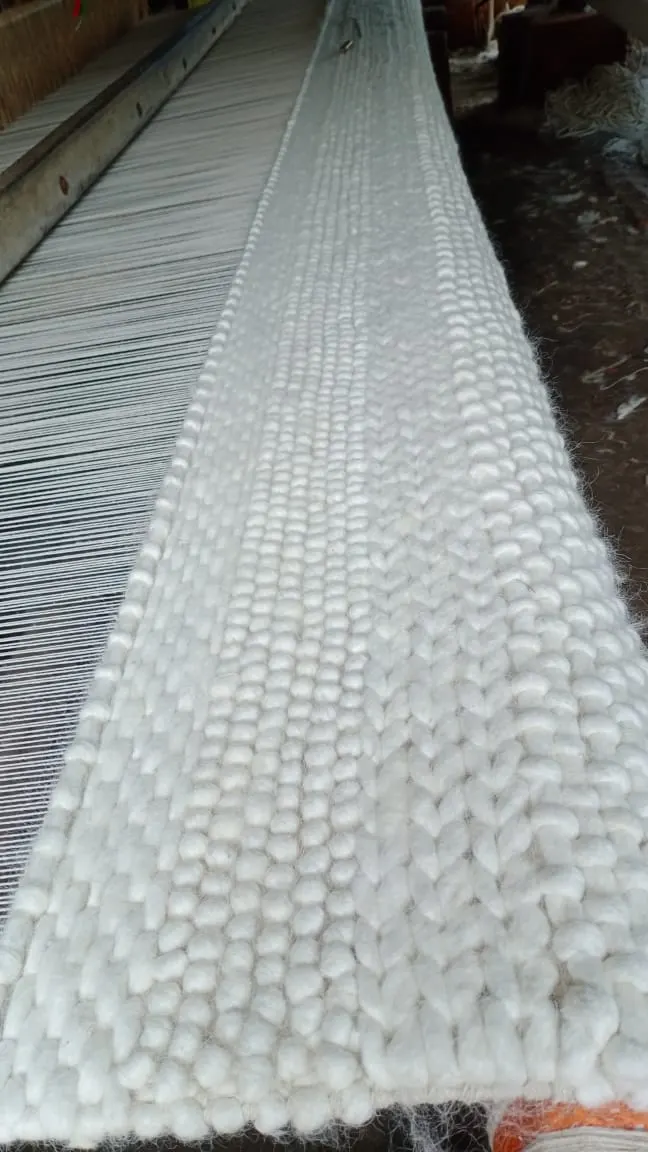
Woven rugs are limited by the loom. Hand-knotted, hand-loom and flatweave rugs are all made on a loom, and a loom is a physical frame that is as wide as it was built to be. The weaver has to reach across it and beat the weft down consistently for weeks. On a wide loom several weavers sit shoulder to shoulder and must stay in rhythm — if one beats harder than the next, you see it in the rug for the rest of its life.
Most handlooms in India run between eight and twelve feet. That covers nearly everything ordered. We weave to twenty, which is wide for this trade.
Hand-tufted rugs are limited by the frame, and frames go much bigger. A tufted rug starts as a full-size drawing traced onto a cotton backing stretched across a frame. The tufting gun works through that backing. Because the design is drawn at actual size before a single tuft is made, and because a frame can be built far larger than a weaver can reach across, the constraint moves — and moves a long way.
Our tufting frames run to thirty feet wide and a hundred and fifty feet long.
That is a ballroom carpet in one continuous piece.
What this means for a hall or ballroom
We have made hall carpets at thirty by eighty feet, and at sixty by one hundred and eighty feet.
The thirty by eighty was tufted as one piece. Thirty feet is inside the frame width, so there is no join anywhere in it — not under the furniture, not in the traffic lanes, nowhere.
Sixty feet is beyond any frame, so a carpet at that scale is planned across sections. But here is where tufting has a second advantage: because the artwork is traced at full size across the whole design before work begins, the pattern registers exactly from one section to the next. It is a drawing-board discipline, not a hopeful alignment at the finishing stage.
What matters at that scale:
The design is planned across sections from the CAD stage, so motifs run continuously and nothing is cut awkwardly at a boundary.
Every section comes from a single dye lot. Colour drifting even fractionally between sections shows badly under hotel lighting, which is usually raking and unforgiving.
Density and pile height are matched section to section.
Joins are hand-finished and placed deliberately — along furniture lines, away from primary sightlines, wherever the layout allows.
And the complete carpet is laid out whole and inspected as one before it ships. Not section by section. All of it, on the floor, at once.
When a seam is a supplier problem
Now the part that should annoy you.
For a woven rug under twenty feet in any direction, a seam usually means the factory could not weave it. Not that the size was impossible — that their loom was too narrow and they took the order anyway.
There are honest ways to handle that: decline it, send it to a wider loom, or say so plainly and let the client decide. What happens more often is two panels sewn together and nobody mentions it.
It rarely shows on day one. A good finisher closes a join well and it will not appear in photographs. But wool moves with humidity and with foot traffic, and two panels do not move identically because they were never one cloth. Within a year or two the join declares itself — a slight ridge, or pile settling at different angles either side and catching the light differently. In a heavy-traffic room it can open. And it is a weak line through a structure that is otherwise continuous, which is where the rug fails first.
The buyer should have made that decision, not discovered it later.
What to ask
For a woven rug:
"What is your maximum loom width, and will this be woven in one piece?"
A number, and a yes. That is a good answer. "We can make any size" is not one, and neither is "our craftsmen can handle it." A factory that has invested in wide looms will give you the number straight away, because they are rather pleased about it.
For a large tufted rug:
"What is your maximum frame size?"
Then: will my carpet fit inside it in one piece? If not, how are the sections planned, will they share a dye lot, and will the whole thing be laid out and inspected before it ships?
Those answers will tell you more about a factory's large-format experience than any brochure.
And at any size, ask for a photograph of your rug in production. Any manufacturer can send one, and it settles every question above.
One more thing — tolerance
A handmade rug is not a machine-cut product. Finished sizes vary by around three per cent, which on a twelve foot square is roughly four inches either way.
If the rug sits tight to a wall, inside a niche, or under a fixed furniture layout, say so at specification. A good factory will work to the lower end of tolerance rather than the nominal size. But it has to be told.
We weave to twenty feet and tuft to thirty by a hundred and fifty in Bhadohi, and we have delivered hall carpets to sixty by one hundred and eighty feet. If you have a large piece in a project, send us the dimensions and we will tell you plainly whether it works in one piece — and if not, exactly how we would build it.