
One roof in Bhadohi — why we dye, weave, wash and finish in-house
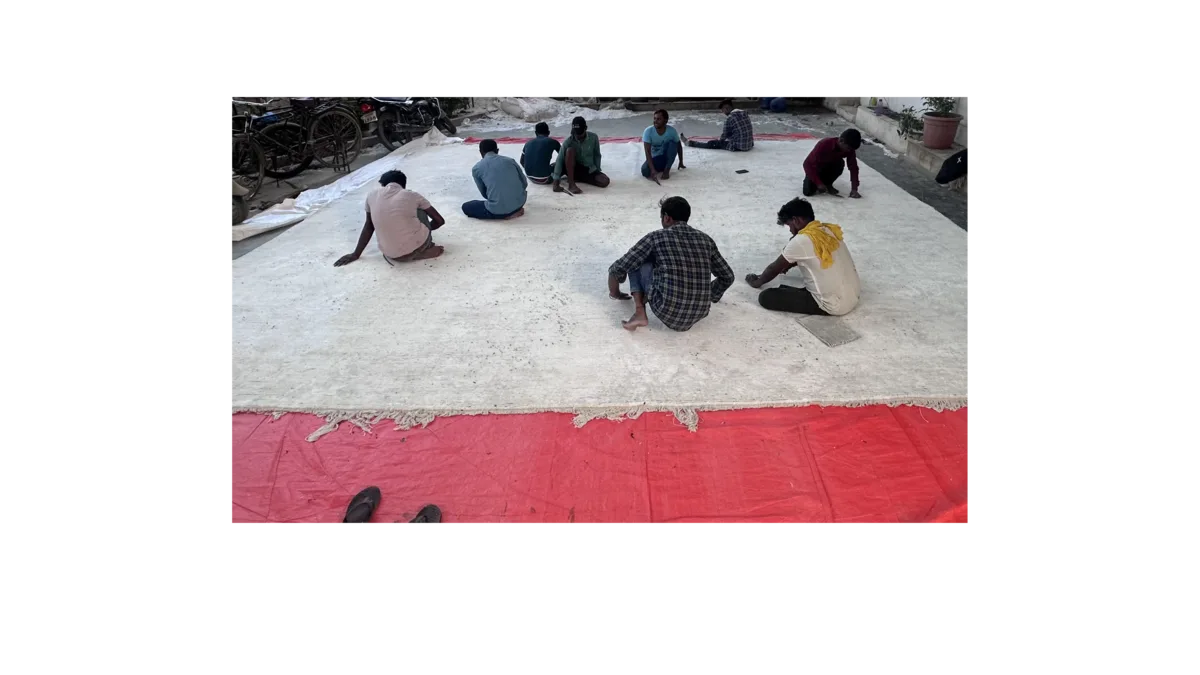
A rug comes off the loom. What happens next tells you almost everything about the factory that made it.
In a lot of Bhadohi that rug now leaves the building. It goes to a wash house in a truck, then to a finisher in another van, and eventually returns to be inspected by the people who took the order in the first place. Every one of those journeys is a handoff. Every handoff is a place quality leaks — and, quietly, a place accountability leaks too.
At PiHue that rug doesn't leave. It moves across the floor.
What "under one roof" actually covers
Fully in-house, in the order the work happens:
Dyeing. Our dye house works to shade cards we've kept and calibrated for years. When a buyer approves a lab dip it becomes an internal recipe, not a note in an email chain with an outside dyer. If a bulk batch drifts, the correction happens the same afternoon. There is no waiting for a vendor to re-book time on their vats.
Weaving. Across the four constructions we make — hand-knotted, hand-tufted, handloom and flatweave — the looms and frames are ours, in our facility and in supervised outlying units on our register. GoodWeave inspects every loom in the network unannounced. The chain of custody from yarn cone to finished piece is a single ledger, not a series of receipts.
Washing. Every rug is washed on our own washing lines. Water and finish steps are matched to the fibre and the construction, not applied uniformly by an outside contractor with a queue of jobs from a dozen factories. The rug that arrives at wash has an ID assigned at off-loom; the rug that leaves wash carries the same ID.
Carving, clipping, binding, finishing. All on the same floor. Buyers who visit find the finishing bay a few steps from the wash line, and the QC bench a few steps from that.
QC and packing. Every finished rug is weighed and measured. GSM against the specified quality, size against the CAD and the SKU, skew held to no more than one inch on any piece. The check is on every piece, not a sample, and outside ±5% GSM the rug is remade — not reworked, not discounted, not shipped. Then it is folded, wrapped and boxed by the people who inspected it.
Why the handoff model quietly erodes quality
Nothing in this section is a criticism of the outside vendors themselves. Wash houses in Bhadohi are skilled. Finishers are skilled. The problem is not the craft, it is the seam between organisations.
Three things go wrong at that seam, again and again:
Colour drift between batches. A dye house that runs jobs for many factories chases its own throughput. Two batches for the same buyer, dyed a week apart, can sit a shade off — and in raking hotel light that half-shade shows badly. When the dye is in our building the second batch is dyed against a physical reference from the first, in front of the same shift.
Loss of chain of custody. When a rug moves through three vendors, three sets of paperwork try to describe the same piece. Reconciling them at the end wastes time and often misses one. Our rugs carry an internal ID from off-loom to shipment, and every stage writes to the same record. Buyers who ask for the receiving trail get one document, not a stack.
Arguing about who caused a defect. If a rug arrives with a wash mark or a finishing scar, the weaver blames the wash house, the wash house blames the loom, and the buyer waits. Under one roof there is nobody to blame. The defect is a PiHue defect, and the answer is a remake.
What this means for audits
The certifications a factory holds are only meaningful to the extent they cover the actual work. When each stage sits in a different building, an audit typically covers what's inside the auditor's own scope and stops at the loading bay.
Because our facility is one address, our audits cover the full flow:
- SMETA (Sedex) covers labour and working conditions across the whole facility, not a fragment.
- GoodWeave inspects every loom in the network unannounced — the mechanism that makes the child-labour-free claim mean something.
- Oeko-Tex Standard 100 is verified by third-party testing at Hohenstein, Germany.
- ISO 9001:2015 covers process control across dye, weave, wash, finish and QC as one system.
- RWS and GRS track certified wool and recycled material end-to-end without transfer certificates changing hands between separate companies.
Documentation and transaction certificates travel with each programme.
What buyers should ask any manufacturer
Three questions cut through most of the ambiguity:
"Which of dyeing, weaving, washing and finishing happens in your own facility — and which is subcontracted?"
Answer should be specific by stage. "All in-house" is easy to say; the question forces the caveats out.
"Which audits cover the whole facility, and which cover only part of it?"
A factory that operates end-to-end can name the scope of each audit. A vendor-assembled operation usually can't, because each audit ends where the vendor changes.
"Can I visit?"
The answer is either yes with a date, or a reason. Buyers who visit us walk from the dye house to the wash line to the finishing bay to QC in one afternoon — because they are all one building.
Frequently asked
Does in-house always mean faster?
Usually yes, because a correction inside one building is a conversation, not a booking. Lead times for our four constructions are on our MOQ & shipping page. Where in-house also helps is on the invisible time — the days that don't show up in the lead-time table because they are the days you are waiting for a vendor to answer.
How do audits cover your facility?
SMETA covers labour and working conditions across the site; GoodWeave inspects every loom in our network unannounced; ISO 9001:2015 covers process control across dye, weave, wash, finish and QC as a single system. Certificate detail is shared with buyers during onboarding. See our certifications page for the full list.
Can buyers visit the factory?
Yes. Buyers regularly visit for programme kickoffs, quality reviews and factory tours. Book a consultation and we will arrange the visit around a working day so you see the floor live.
If you are evaluating manufacturers for a private label, a hotel programme or a first custom order, and want to see how the whole chain works in one place, write to us. We will send a floor plan, a certifications summary and a same-day answer on your specification.