
Ecru rugs: natural undyed wool from the Bhadohi floor
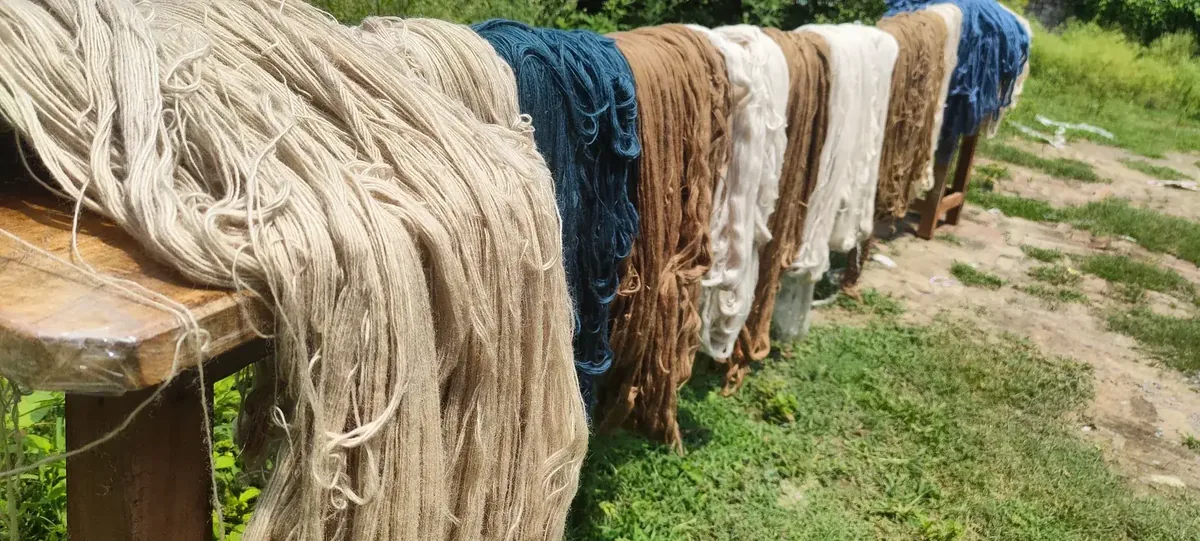
Ecru is a buyer term that walks into our enquiry inbox most weeks, usually attached to a request for a programme that will not have to be re-matched year on year. It is one of the most forgiving briefs we take, and one of the most specific — because "ecru" in rug language sits on top of a stack of smaller words that each need settling before the loom starts.
What ecru means at the factory
In our usage, ecru is the family of pale, warm neutrals produced either by weaving undyed sheep's wool directly, or by matching to a specified ecru reference in a shallow dyebath. The two routes look alike and age differently: an undyed yarn carries the natural lanolin and the mild shade variation of the fleece it came from; a dyed-to-ecru yarn carries a locked recipe we can repeat for ten years. Which route is right depends on how your retail promise is written.
The term overlaps with greige (raw, unfinished), natural (undyed) and off-white or bone (shade descriptions, often dyed). Our quotation sheet asks you to pick a lane; if you are not sure, the sampling path below settles it in two weeks.
Construction options we weave in ecru
Ecru is a colour brief, not a construction brief — every technique we run on the floor is available in natural or ecru-matched yarn.
- Hand-knotted. The route for heirloom and gallery programmes. In undyed wool, the pile ages with the warmth most ecru briefs are actually chasing. Knot counts to specification.
- Hand-tufted. The route for fast, textured programmes — loop, cut, high-low, carved relief — where ecru is doing structural work rather than colour work. Faster lead time than knotted at comparable GSM.
- Handloom. The route for broadloom and runner programmes — long widths in a plain or lightly figured natural, consistent across cuts.
- Flatweave. Dhurrie and kilim constructions in natural wool, cotton or jute, lightest in weight, suitable for layering and warm climates.

The ecru shade range we weave to
When a brief says "ecru", it usually resolves to one of four shades on our floor. If a swatch or Pantone is supplied we match to that; if not, we sample these as the starting set:
- Bone — the palest, closest to a cream-white; the dyebath route only, because natural wool rarely reaches this value without bleaching, which we do not do.
- Oatmeal — warm pale neutral with a faint grey undertone. The commonest "ecru" in practice.
- Sand — one step warmer and deeper than oatmeal, trending yellow-brown.
- Stone — cooler, mid-neutral, trending grey-brown. Reads modern against pale timber floors.
Natural undyed wool typically occupies the oatmeal–sand band. Bone and the lightest ecru almost always need a shallow dyebath, which brings us to specification.
How we specify ecru so it repeats
Three documents sit under every ecru programme we run:
- A colour reference — a Pantone number, an ARS 1400 code, or an approved physical swatch. We work from all three; the lab dip reconciles them to a single locked recipe.
- A yarn specification — fibre (New Zealand wool, local wool, cotton, jute), spin count, and whether the yarn is undyed or dyed-to-match. This is where the greige-vs-dyed decision gets committed.
- A GSM target with ±5% tolerance in writing on the purchase order. GSM — grams per square metre — is the specification that catches quiet substitution; we weigh every finished rug on a calibrated scale and record it on the receiving slip. Outside tolerance means a remake, not a discount. The full method is in how we verify GSM on every rug.
Dimension carries a separate ±3% size tolerance, measured at multiple points because handmade pieces breathe. The specifications sheet has the full set of tolerances we commit to in writing.
Why ecru programmes are harder than they look
Pale neutrals expose everything a darker rug hides. Three risks sit under every ecru brief:
Metamerism. A yarn that reads correctly under showroom light can read warmer under daylight or cooler under LED. For ecru this is more visible than for any mid-tone, because the eye has no colour reference to anchor against. Our lab dip process checks every candidate recipe under a daylight simulator before it reaches you — this is the single step we never skip on an ecru programme.
Fibre consistency. Natural wool varies hank to hank. For an undyed programme we blend across spin lots before weaving to keep the shade range tight; for a dyed-to-ecru programme we lock a dyer, a vat and a recipe for the full order quantity. Changing any of them mid-run is treated as a new sample.
Soiling and wash. Pale rugs show every mark. Our wash recipe for ecru pieces is gentler than our standard — hotter water strips the lanolin that gives natural wool its hand, so we take washing temperature and chemistry down a notch and compensate elsewhere.

Sampling path, lead time and MOQ
For most ecru programmes the sampling path runs:
- Enquiry → quotation within one working day of a brief with sizes, quantities and a colour reference.
- Lab dip for dyed-to-match ecru — around ten days from reference to approved recipe. Skipped for pure undyed yarn briefs.
- Strike-off — a small physical sample at target GSM, around fifteen days from recipe lock.
- Production — lead time depends on construction, quantity and finish. The full picture is on MOQ, lead times and shipping.
MOQ for an ecru programme is treated the same as any other colour programme — we work with brands running single-piece gallery editions and with retailers running container-scale drops. If you are testing an ecru line, a short-run sampling order is a reasonable first step.
Private label and custom development
Ecru programmes often become a brand's quiet workhorse — the colour a buyer stocks every season while the pattern lines change around it. We run these under private label, including woven-in brand labels and buyer-supplied barcoding, and under custom development for designer-led programmes starting from a CAD or a sketch. The custom rugs overview walks through what a brief needs to contain.
If you have been emailing about ecru and want to move from conversation to quotation, send a size, a quantity and either a Pantone or a photo. We will reply the same working day with pricing, construction options and a sampling plan.