
Handmade rug manufacturing in Bhadohi, India.
PiHue Creations is a handmade rug manufacturer in Bhadohi, Uttar Pradesh — the GI-tagged carpet cluster of India — producing hand-knotted, hand-loom, hand-tufted and flatweave rugs for retail brands, interior designers and hospitality projects worldwide.
Founded in 2021. Washing, finishing and QC under our own supervision; dyeing at a contracted OEKO-TEX and RWS certified plant. The commercial floor of the operation is MOQ of one piece, sampling in about 15 days and a quotation returned the same working day.
- 1 pieceMinimum order
- 20 ftLoom width, one piece
- 1 kgMinimum dye lot
- 6Certifications
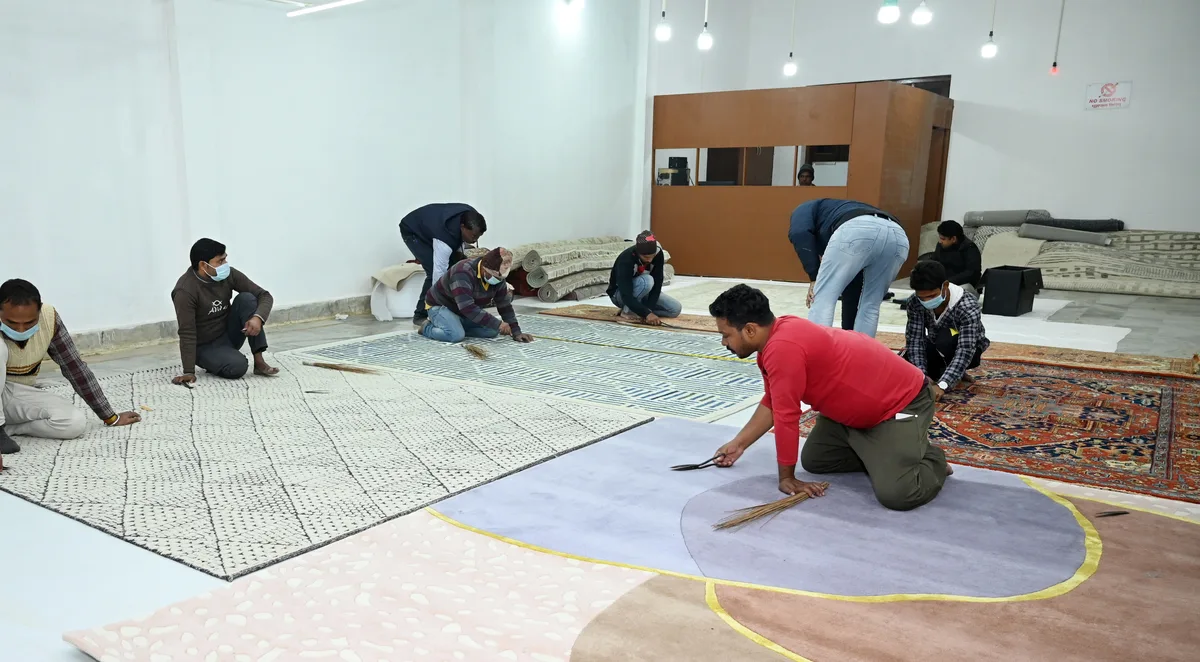
What we manufacture
Four constructions, run side by side on the same floor. Most factories specialise in one and subcontract the rest, which means a client building a collection across price points ends up dealing with three vendors and three standards. Here it is one vendor, one QC, one commercial contact.
Hand-knotted rugs 35–130 days
Hand-knotted is our finest and most durable work — each individual knot tied by hand around a cotton or wool warp. This is the construction with the longest history in Bhadohi and the one that still commands the highest price point: the knots are tied one at a time by a weaver over months, and the finished piece is built to last decades. The visual signature is a defined pattern with fine detail on the face and a matching pattern on the reverse. Because there is no latex, no backing and no shortcuts, hand-knotted rugs wash without structural risk and re-pile if needed after many years of use. We hand-knot on cotton or wool foundation, in wool, silk and bamboo-silk pile. Knot density is specified per design, from 20 KPSI up to 150 KPSI in wool and 180 KPSI in pure silk. Lead time steps with knot density, from 35 days at the open end to 130 days at 180 KPSI in pure silk. See the full hand-knotted process page for how the knot is tied and the loom set up, and the glossary entry on KPSI for what knot density means in practice.


| Specification | Value |
|---|---|
| Knot density | 20–180 KPSI, specified per design (150 wool ceiling, 180 pure silk) |
| Pile fibres | Wool, silk, bamboo silk |
| Foundation | Cotton or wool warp |
| Lead time | 35–130 days from strike-off approval, banded by knot density |
Hand-loom rugs 30–60 days, 30 urgent
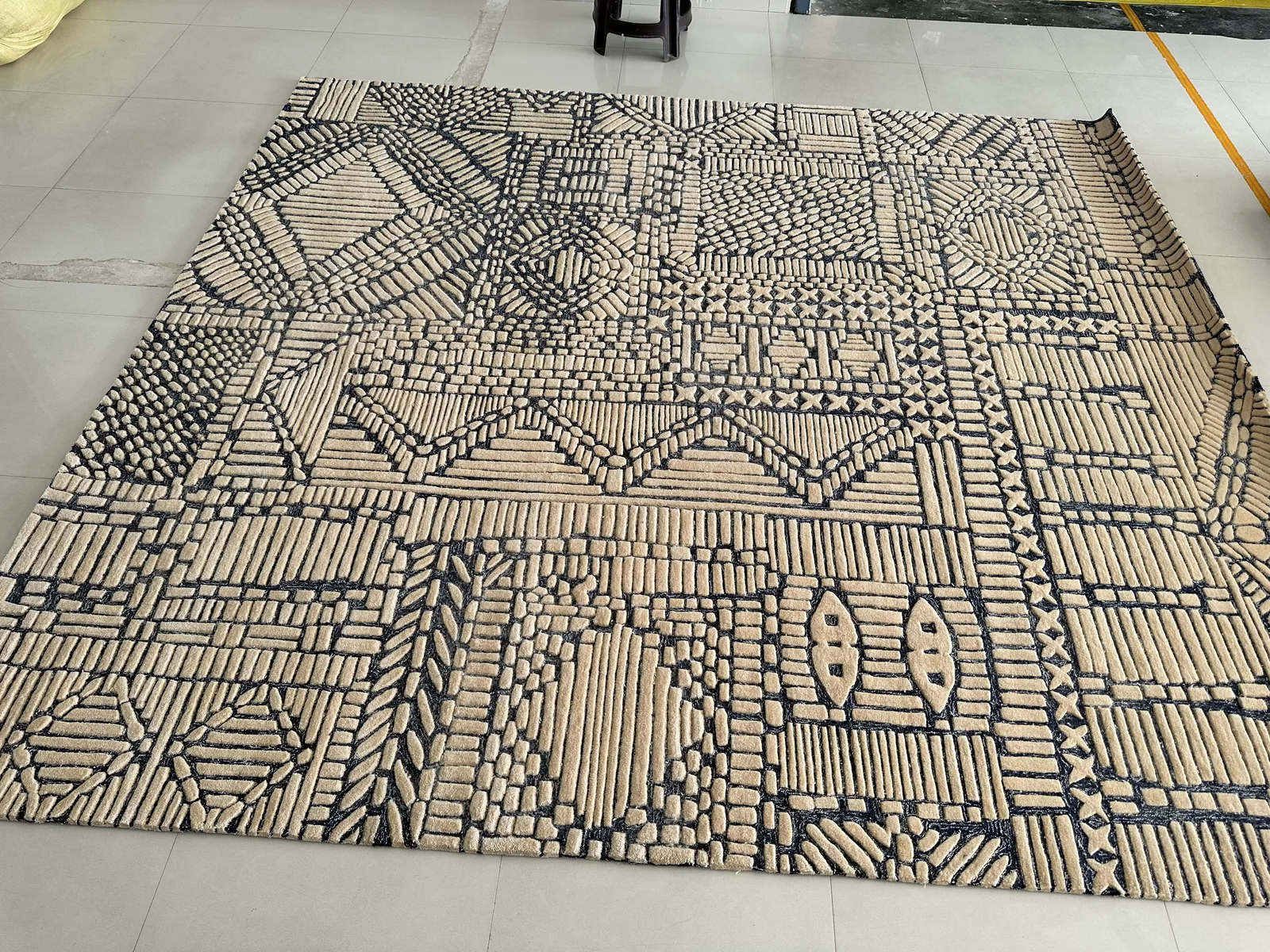
Hand-loom is woven on the loom rather than tufted — warp and weft interlaced by hand, no latex, no bonded backing, no adhesive. Because the structure is the weave itself, a hand-loom rug washes without structural risk, folds without marking, and cannot delaminate. It is also where our most interesting surfaces come from: chunky loop and pebble textures built from varied yarn thickness and varied loop height, made in the weaver's hands rather than added at the finishing stage. The construction accepts cut pile, loop pile, or mixed cut-and-loop for high-low texture, at weights from 2500 to 5000 GSM and loop heights from 5 to 12 mm. Because there is no backing, hand-loom is the honest construction for buyers who want a piece that ages well and can be re-cleaned repeatedly through its life. Lead times run 30 to 60 days from strike-off approval as standard, and can be compressed to 30 days on urgent orders. Read the handloom construction page for the difference between broadloom and area handloom, and the glossary entry on pile height for how surface height affects hand and wear.
| Specification | Value |
|---|---|
| Weight range | 2500–5000 GSM |
| Loop height | 5–12 mm |
| Surface types | Cut · Loop · Mixed height |
| Lead time | 30–60 days from strike-off approval, 30 on urgent orders |
Hand-tufted rugs 35–45 days
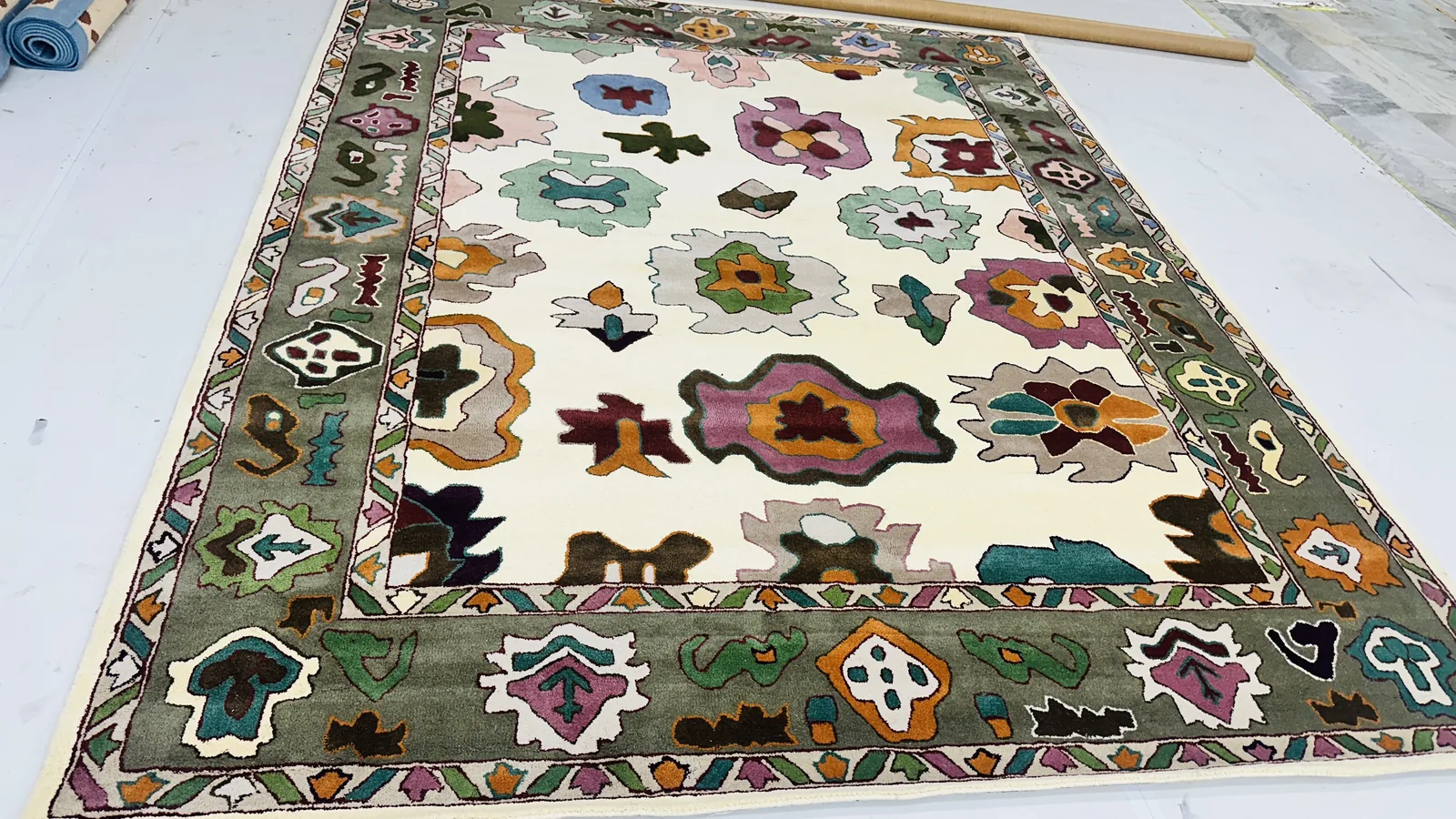
Hand-tufted is the most versatile construction for complex artwork. Yarn is punched by hand through a primary canvas stretched on a frame, then locked in place with a controlled latex layer and bonded to a secondary cotton or synthetic backing. Colour count is effectively unlimited — the design comes off a scaled drawing traced onto the canvas — and intricate figurative or high-detail geometric patterns reproduce faithfully. Lead times are meaningfully shorter than hand-knotted work at a considerably lower price point, which is why hand-tufted serves most retail and hospitality programmes. We hand-tuft in wool from 2000 to 3500 GSM at pile heights from 8 to 18 mm; silk and viscose pieces go higher on GSM. Lead times run 35 to 45 days from strike-off approval. See the hand-tufted process page for how the tufting gun is used and how the latex layer is controlled, and the glossary entry on GSM for how weight relates to density.
| Specification | Value |
|---|---|
| GSM (wool) | 2000–3500 GSM; higher in silk and viscose |
| Pile height | 8–18 mm |
| Lead time | 35–45 days from strike-off approval |
Flatweave and dhurrie rugs 35–45 days
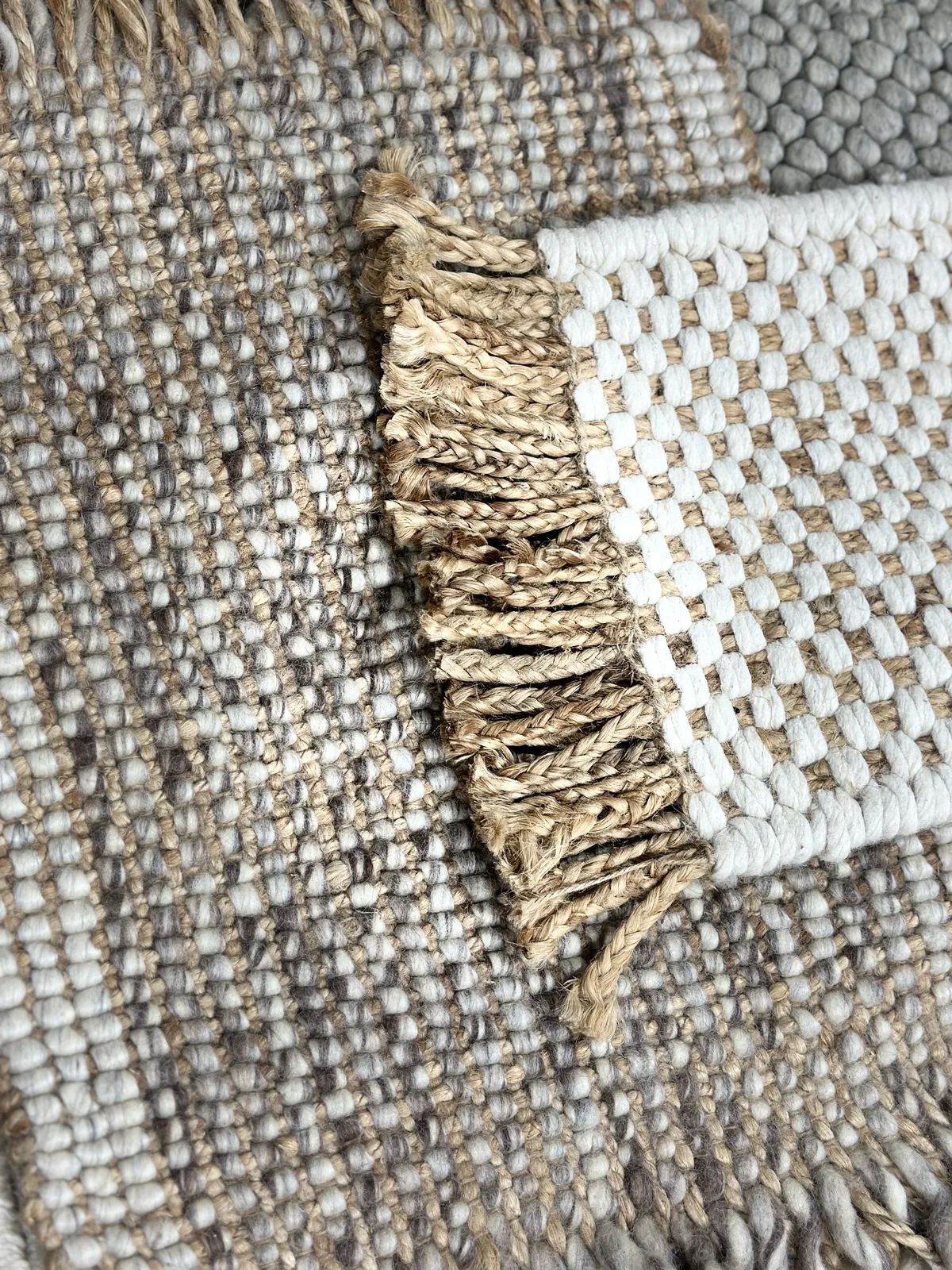
Flatweave and dhurrie rugs are woven without pile — the design lives entirely in the interlaced warp and weft, both sides of the finished rug are usable, and the whole piece washes easily. That combination makes flatweaves the honest choice for high-traffic areas, for layered schemes where a rug sits under another rug, and for seasonal rotation where a client wants a lighter surface for summer. Because there is no pile to tension or shear, flatweaves are the lightest of the four constructions to ship and the most straightforward to package flat rather than rolled. We flatweave in wool, cotton, jute and recycled PET at weights from 1200 to 5000 GSM, in classic Indian dhurrie construction. Lead times run 35 to 45 days from strike-off approval. Read the flatweave construction page for the difference between dhurrie and kilim, and the jute materials page for the natural-fibre option.
| Specification | Value |
|---|---|
| Weight range | 1200–5000 GSM |
| Fibres | Wool · Cotton · Jute · Recycled PET |
| Constructions | Dhurrie flatweaves |
| Lead time | 35–45 days from strike-off approval |
How a rug is made here
Every rug on our floor moves through the same twelve stages, whether it is a one-off strike-off or a container programme. The vocabulary comes from Bhadohi — folio, bazar, shade card — because that is how the floor actually runs. Verification is built into the flow, not bolted on at the end: yarn is checked before it becomes anything, colour is fixed against the shade card before bulk dyeing, GSM is verified on every piece as it comes off the loom, and every issue of yarn is reconciled against the work order for the piece it belongs to. Traceability is a consequence of the workflow, not a separate report. What follows is the sequence, exactly as it happens.
-
Yarn intake
Wool is tested before anything else happens to it — count on the wrap reel, twist on the twist tester, moisture regain in the hot-air oven, weight on the calibrated analytical balance. RWS-certified wool carries transaction certificates from farm forward.
-
Shade card and lab dips
Colour is fixed against the shade card before bulk dyeing. Lab dips matched to Pantone and ARS 1400 references, returned for approval in about ten days. Minimum dye lot is one kilogram, so a custom colourway is available on a single rug.
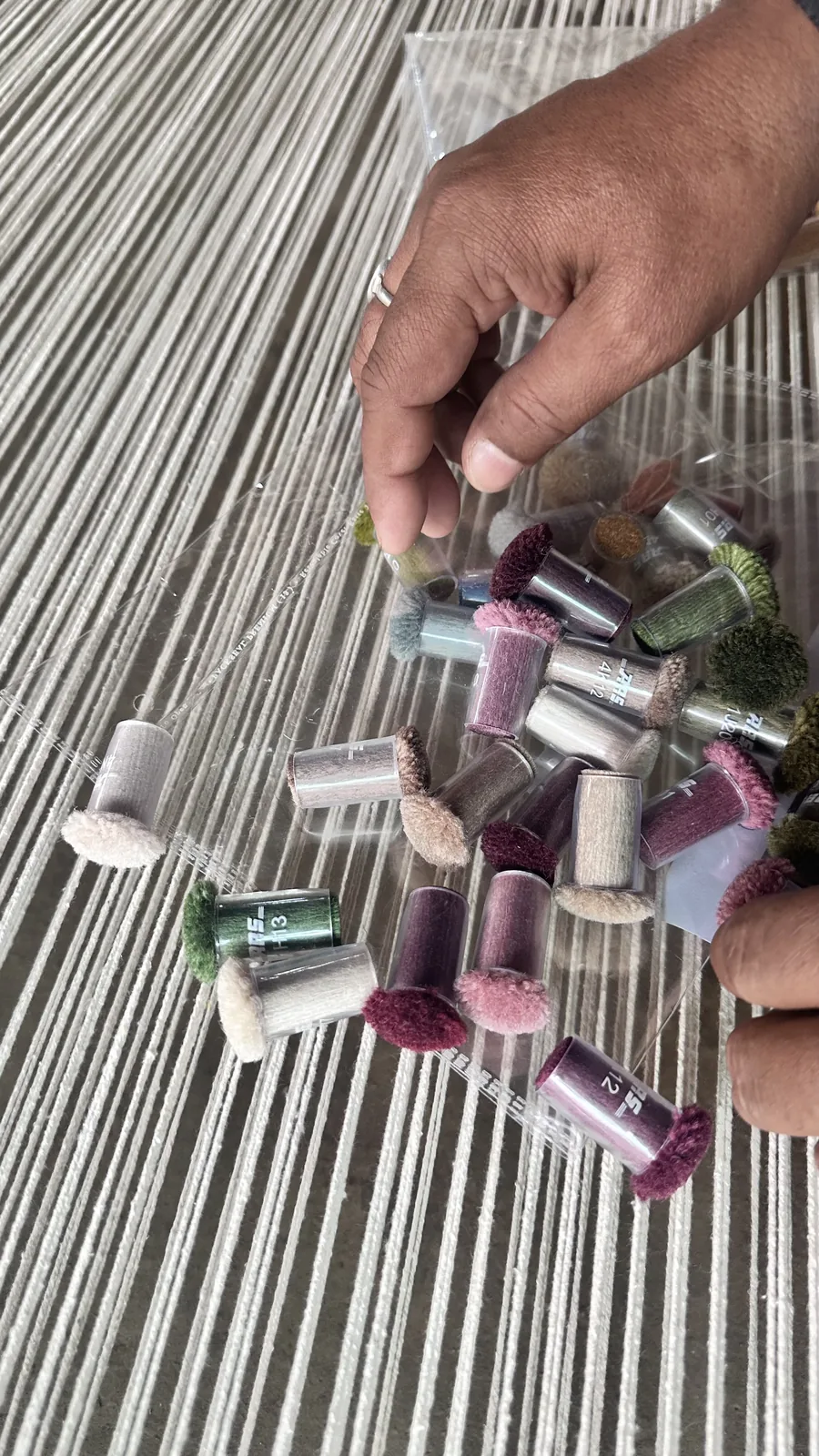
Shade cards and lab dips — matched to reference before bulk dyeing. -
Dyeing
Dyeing happens at a contracted OEKO-TEX and RWS certified plant. Colour fastness tested against reference under standard light before the yarn is released to the loom.
-
Drying
Dyed hanks are dried before spinning or issue. Sun-drying where the weather allows, controlled drying otherwise. Nothing goes to the loom damp.
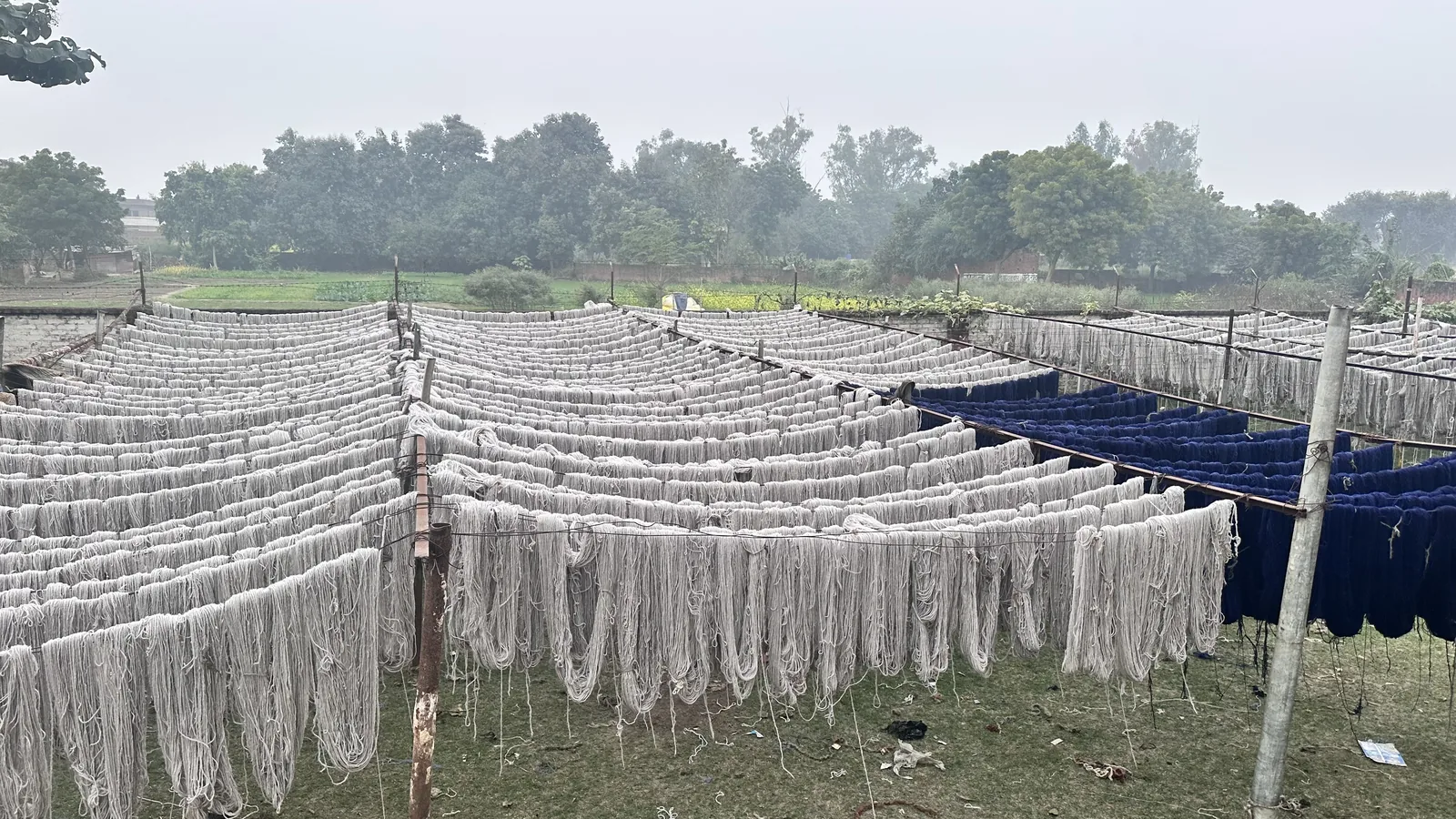
Dyed hanks drying — the range that makes a palette possible. -
Spinning
Handspun yarn is produced within our own operation; mill-spun yarn is sourced to specification. Custom blends — mohair-and-wool, Merino-and-New-Zealand, wool-and-nylon — are made to order from a 5 kg spin lot.
Wool spinning on the floor. -
Work order (folio)
Each rug or batch is issued as a work order carrying size, design, quality, shade reference and the yarn requirement per square metre, calculated from the shade card. The folio travels with the piece from issue to bazar.
-
Yarn issue and accountability
Yarn is issued against the work order's per-square-metre requirement. Consumption is reconciled on return; any shortage carries forward against the next issue. Nothing leaves the store unaccounted.
-
Weaving
On the loom, up to 20 ft in width, woven as a single piece with no seam. Lobby, ballroom and banquet-scale pieces run whole up to that limit.
A wide floral rug on the loom — woven whole, no seam. -
Receiving (bazar)
Finished pieces are received daily against slips. GSM is calculated and verified on every single piece as it comes off the loom — not sampled, every piece. See how we verify GSM on every rug.
-
Clipping, carving and finishing
The pile is clipped to specified height, carved where the design calls for high-low relief, and the surface finished ready for wash.
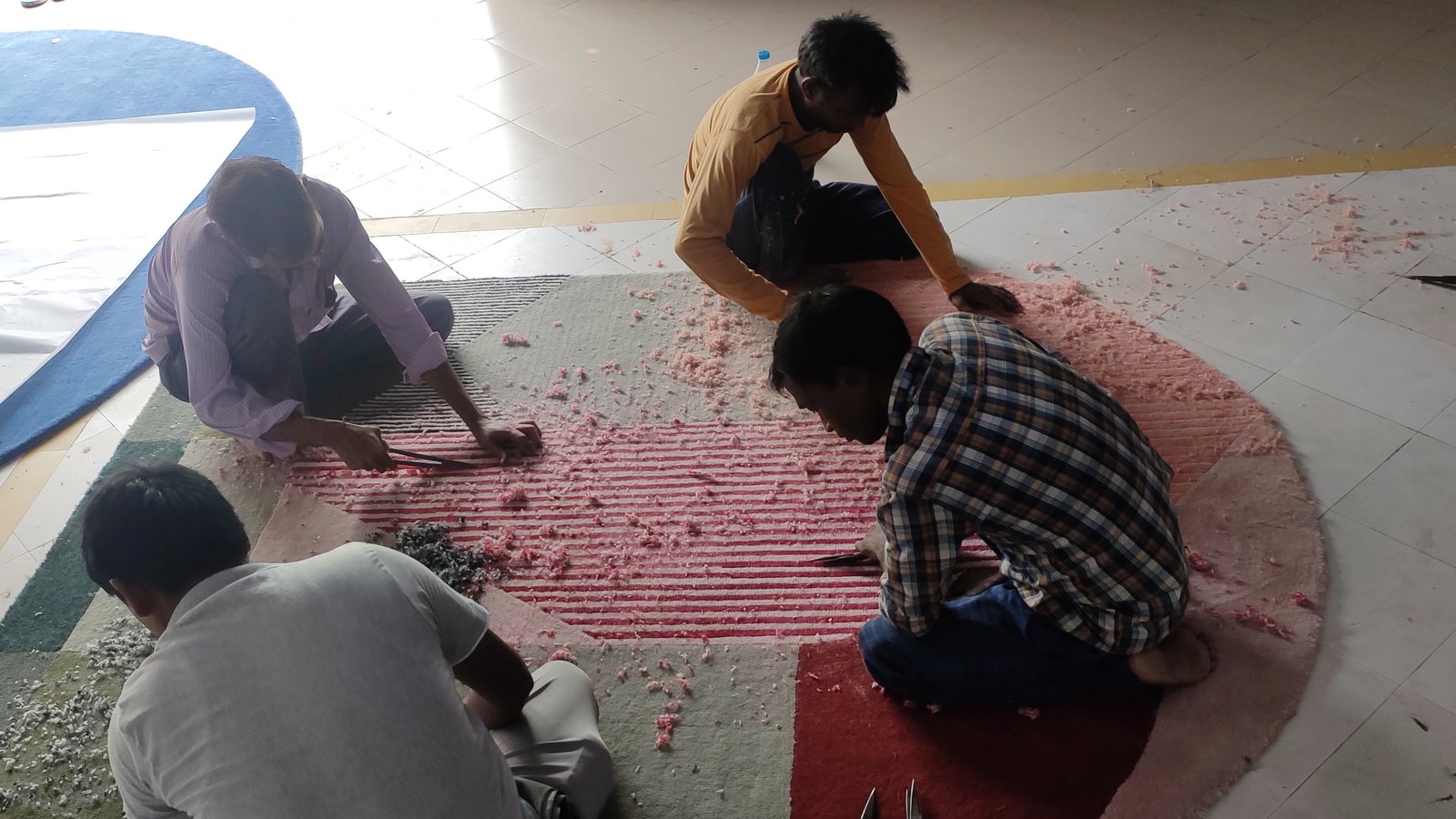
Carving by hand — four artisans on one piece. 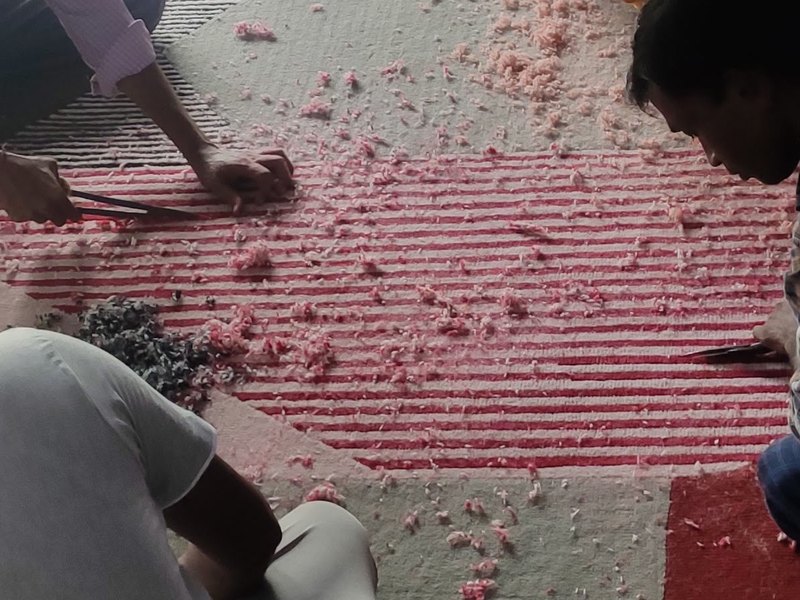
Blade cutting ribbed relief into the pile — carving detail. Clipping and finishing on the bench. A carved rug being checked at the finishing stage. -
Washing and drying
Every rug is washed and dried before final QC. Sun-drying where the weather allows — the traditional finish still holds a piece flat and settles the pile the way no dryer does.
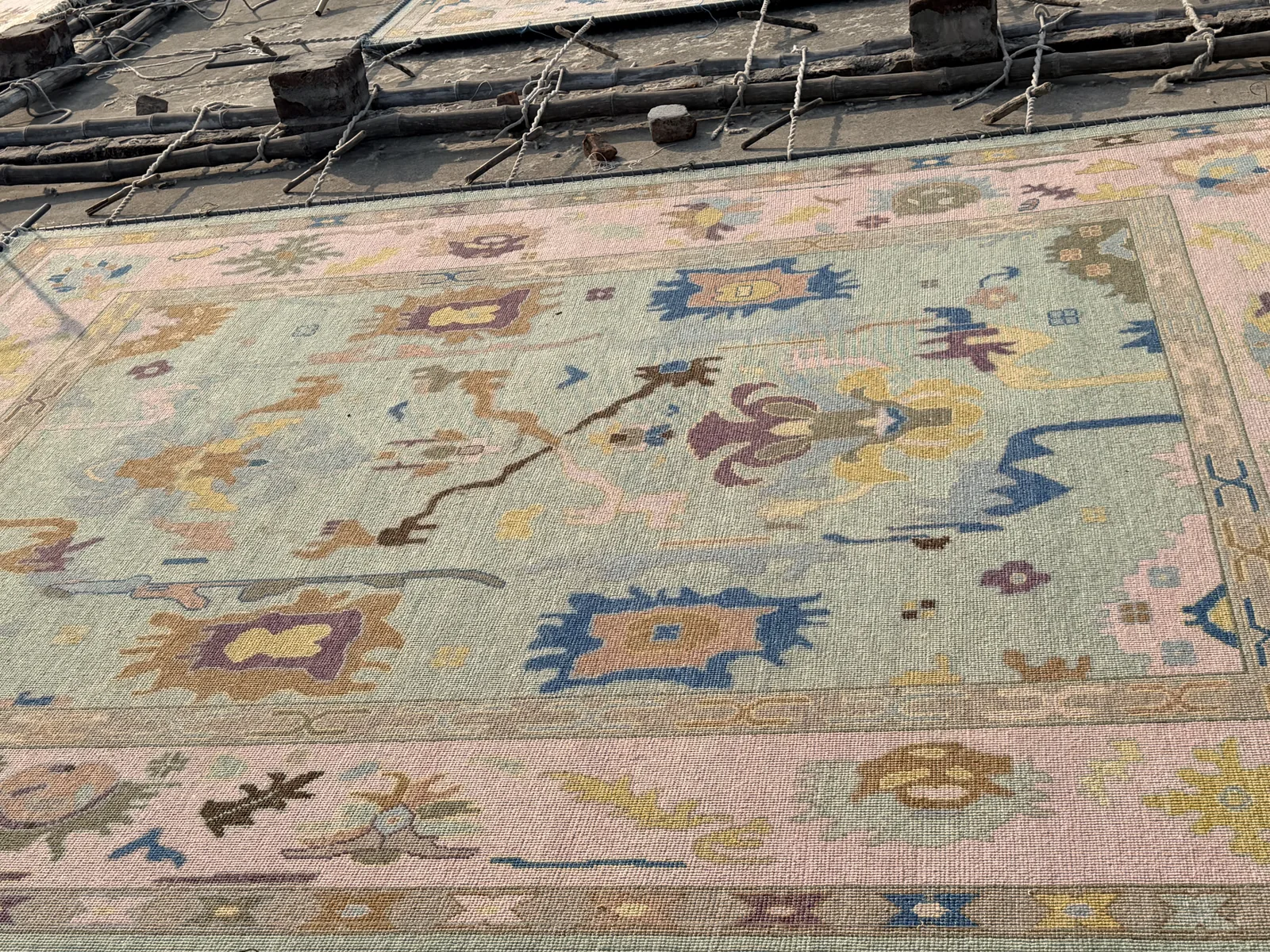
Sun-dried hand-knotted rug — a whole-piece format woven without a seam. -
Final QC, packing and documentation
Dimensions to ±3%, pile, binding and finish verified against the approved sample. Bale marking, private label where specified, and full export documentation — packing list per rug and per pallet, commercial invoice, certificate of origin, transaction certificates for RWS, GRS or OEKO-TEX programmes.
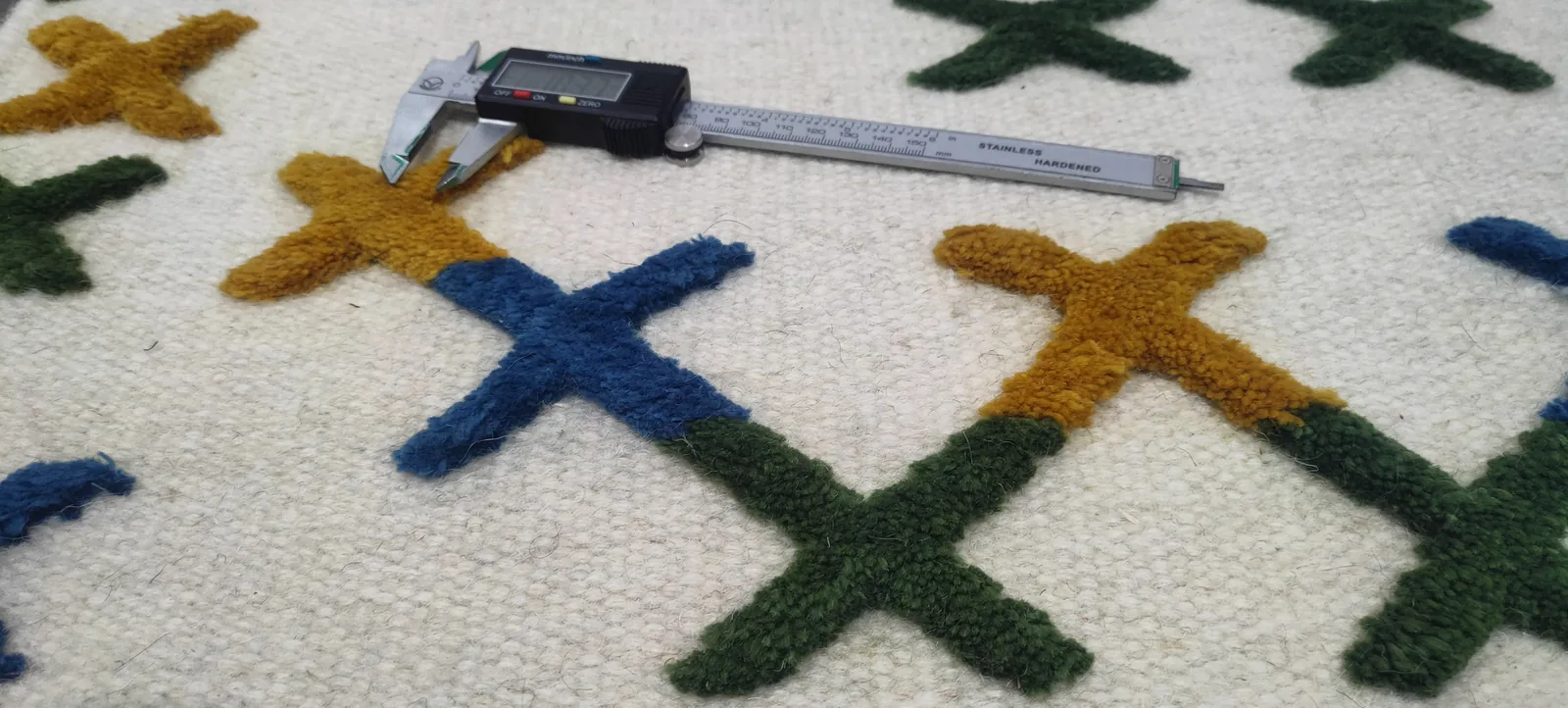
Digital caliper — every piece. 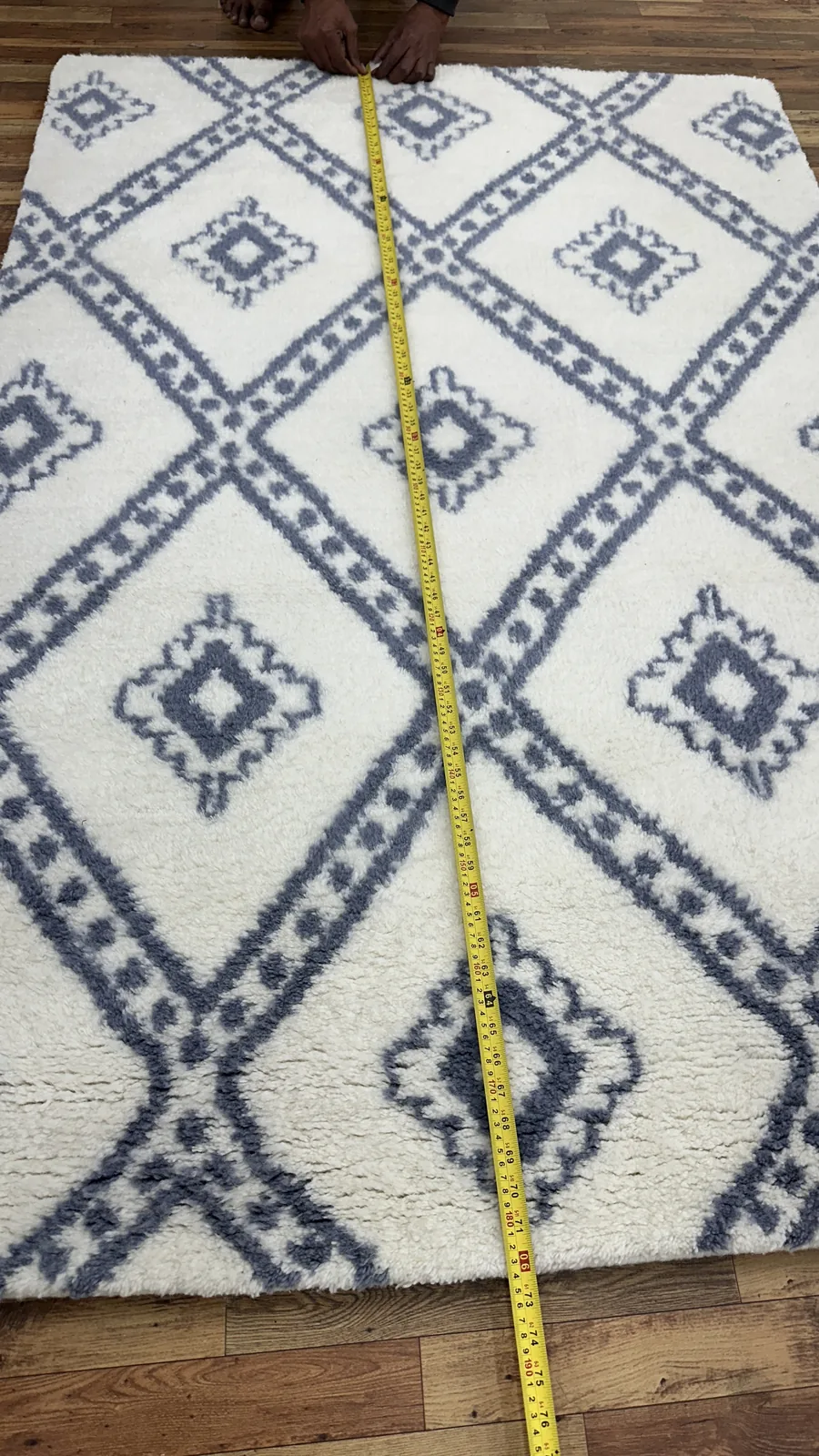
Tape measure — the full-length dimensional check. 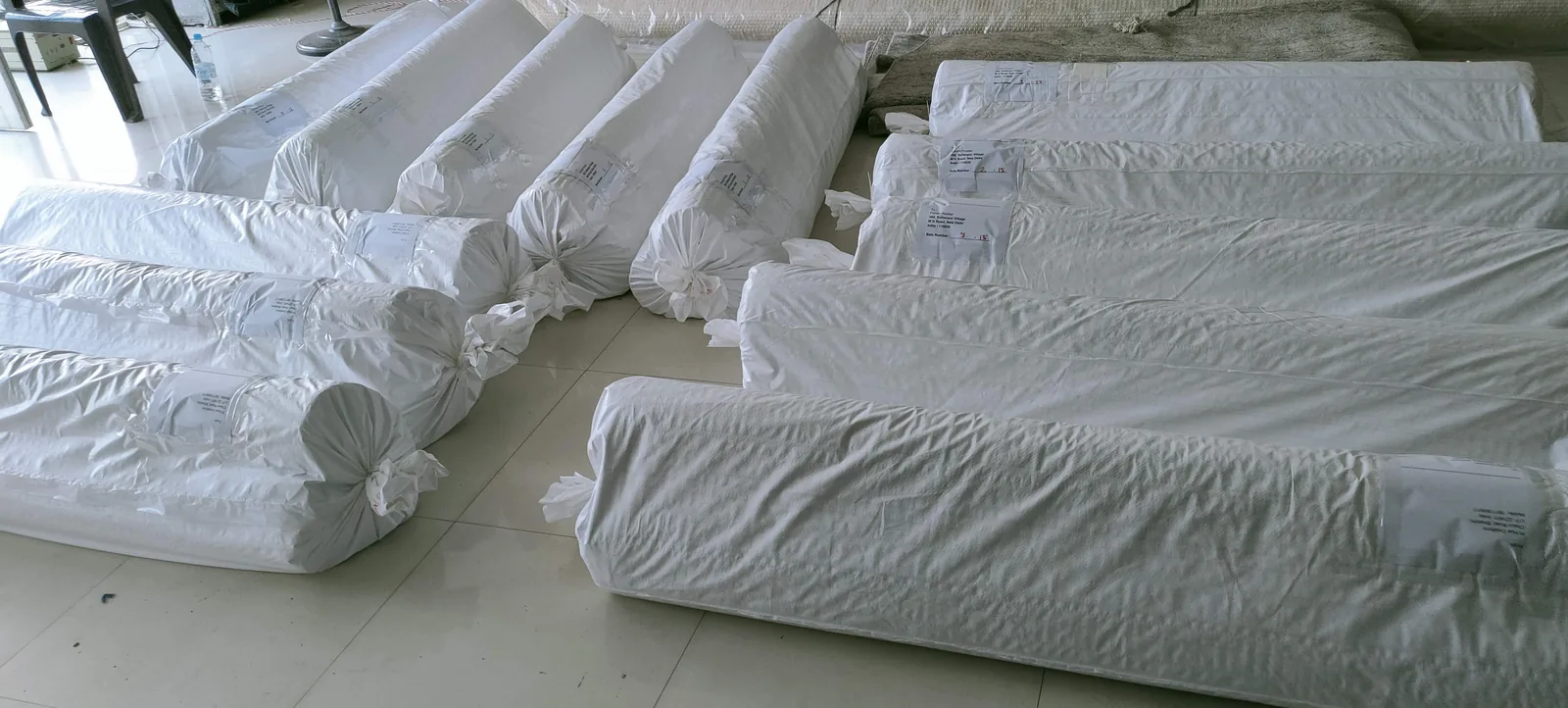
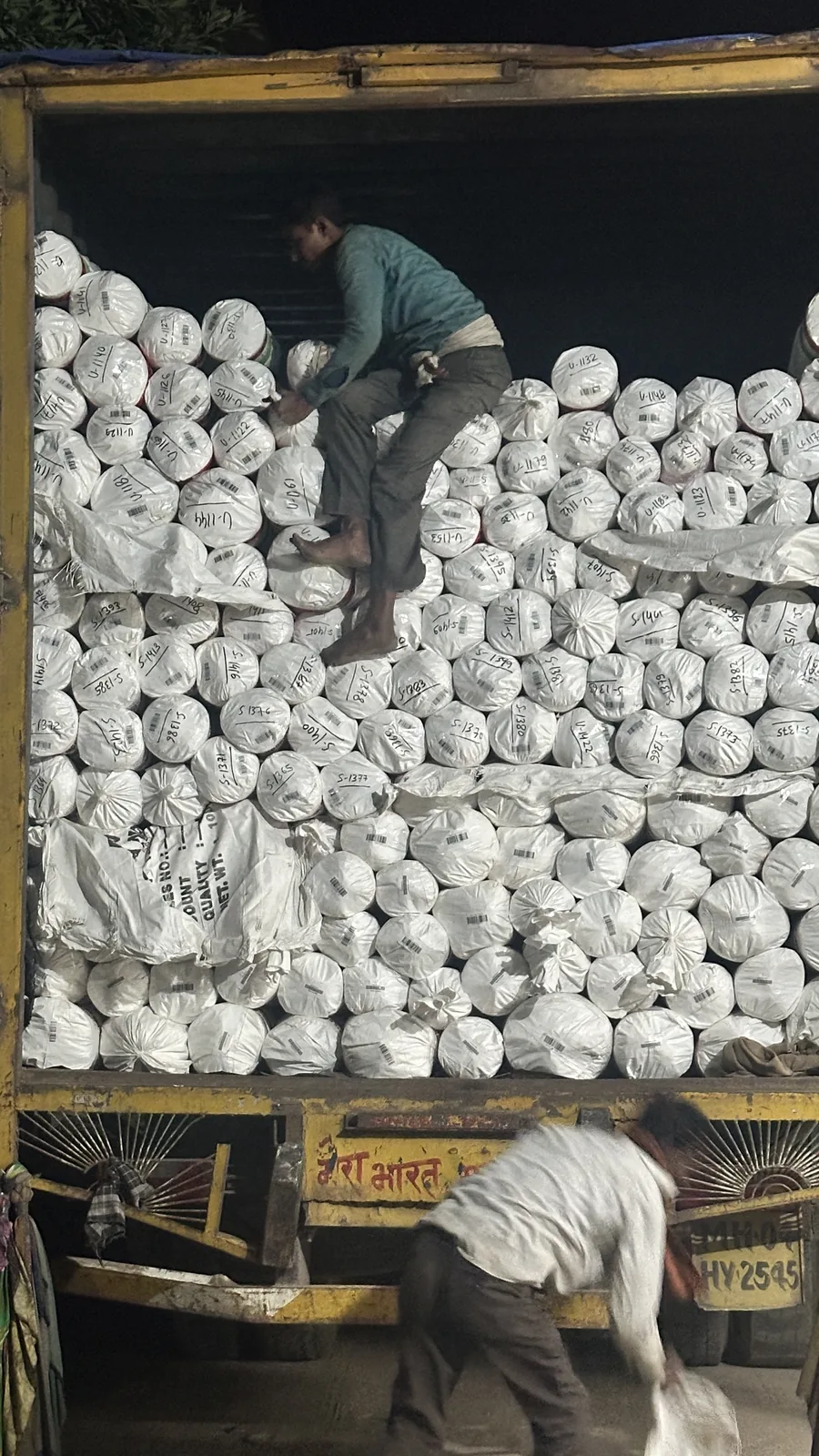
Labelled bundles — ready for the forwarder.


Traceability. RWS wool is traceable to audited farms; GRS transaction certificates travel at every handoff between trader, dyer, weaver and exporter; GoodWeave inspection covers the full supply chain including subcontracted home looms. The provenance is not a report generated at the end — it is the sum of the twelve stages above. Editors and researchers verifying our claims can find licence numbers and boilerplate on our press page.
Scale, sizes and lead times
Two numbers matter most on a working manufacturing floor: the widest loom you can weave without a seam, and the smallest quantity you can produce economically. Both determine which projects a factory can actually take.
Loom width and maximum sizes
Our maximum loom width is 20 ft, the usual constraint on large-format rugs and the reason many suppliers quietly propose seaming an oversized piece. We weave lobby, ballroom and banquet-scale pieces in one piece, without a seam, up to that limit. For pieces above 20 ft in the shortest dimension we discuss the project on its specifics — some designs join well, others do not.
Lead times by construction
Lead times below are from strike-off approval, which typically sits about 15 days after CAD approval and lab dip. Mixed orders across several designs track the slowest construction in the set, not the sum.
| Construction | Lead time from strike-off |
|---|---|
| Hand-knotted | 35–130 days, banded by knot density |
| Hand-loom | 30–60 days, 30 on urgent orders |
| Hand-tufted | 35–45 days |
| Flatweave / dhurrie | 35–45 days |
Large format — hall and ballroom carpets
Two size constraints run on our floor, and they differ by construction. This is the distinction most specifiers do not know, and it is the reason we can take work others must refuse.
A woven rug — hand-knotted, hand-loom, or flatweave — is limited by loom width. Weavers must reach across the loom and beat the weft consistently for weeks; that constraint puts most Indian handlooms between eight and twelve feet. Our looms run to 20 ft, woven in one piece, and 20 ft is wide for the trade. It is also the point at which most suppliers quietly begin seaming and hoping the join goes unnoticed.
A hand-tufted rug is limited by frame size, and frames go much bigger. Because the design is traced full-size onto backing before a single tuft is made, the frame can be built far larger than a weaver could reach across. Our tufting frames run to 30 ft × 150 ft. A 30 × 80 ft hall carpet is one continuous piece — no join under the furniture, no join in the traffic lanes, none anywhere.
Beyond frame size, sections become unavoidable. We have delivered 60 × 180 ft as a sectioned piece. When we work at that scale the whole design is traced at full size across every section at the CAD stage, so motifs run continuously and registration is exact. Every section comes from a single dye lot, density and pile height are matched section to section, and joins are hand-finished and placed deliberately along furniture lines and away from primary sightlines. The complete carpet is laid out whole on the floor and inspected as one before it ships — not section by section, all of it, at once.
Typical applications: hotel ballrooms, banquet halls, conference floors, lobbies, restaurants, spas, residential amenity spaces. For the reasoning in plain-buyer language on when a seam is a supplier problem versus genuinely unavoidable, read why large rugs get seamed — and why some don't need to be. To brief a specific project, the for-buyers hub lists what to send us.
| Specification | Value |
|---|---|
| Maximum one-piece width — woven | 20 ft |
| Maximum one-piece — hand-tufted | 30 ft × 150 ft |
| Largest delivered, sectioned | 60 ft × 180 ft |
| Constructions available at scale | hand-knotted · hand-loom · hand-tufted · flatweave |
| Design registration across sections | traced full-size at CAD stage |
| Dye lot | single lot across all sections |
| Pre-dispatch | complete carpet laid out and inspected as one |
Custom shapes
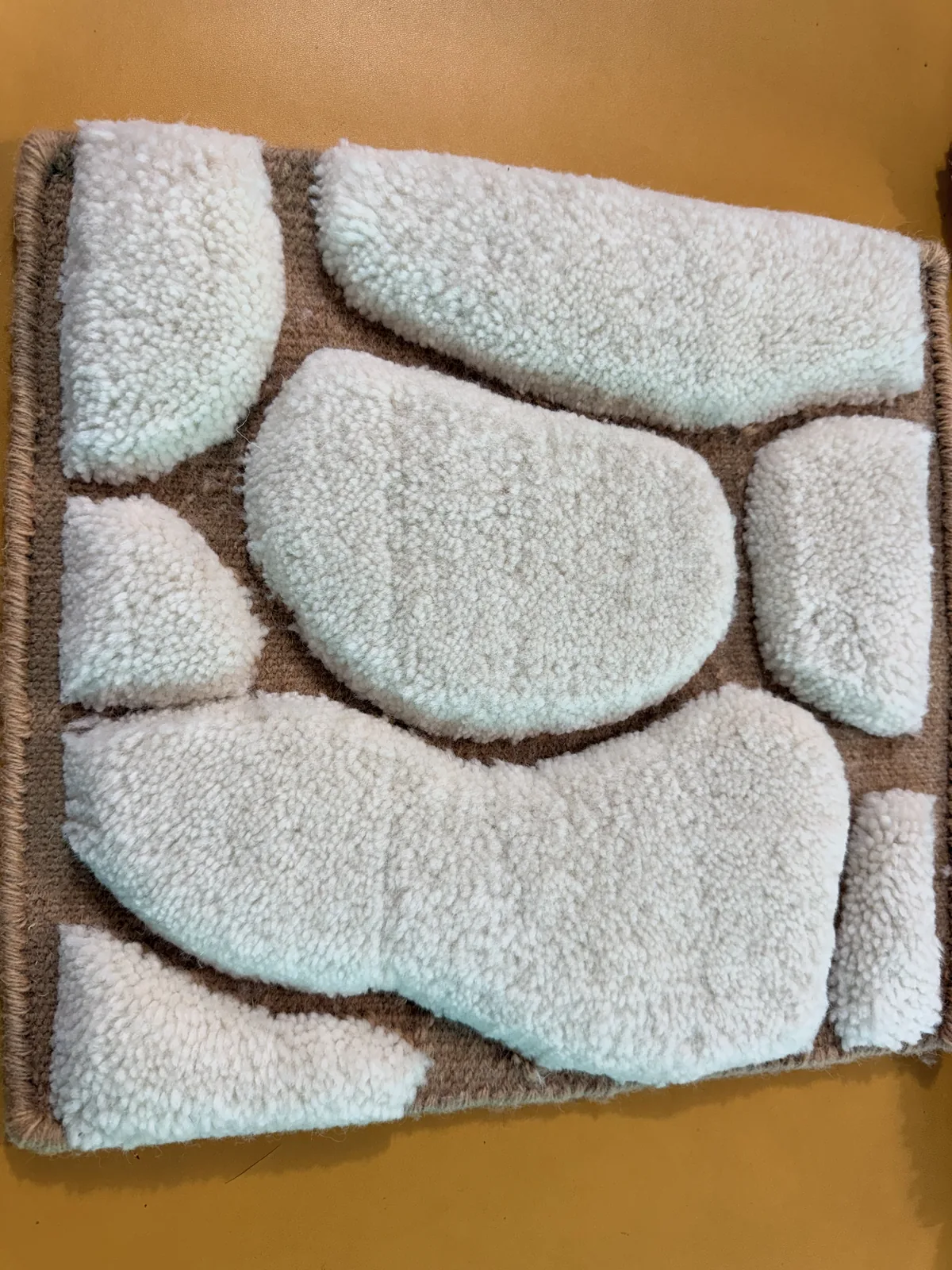
Rounds, ovals, kidneys and other bespoke outlines are cut and bound to specification. MOQ is one piece and the size tolerance is ±3%, the same as any rectangular programme.

Fibres and materials
Every fibre listed below is certified. Most are tested to OEKO-TEX Standard 100; recycled PET is additionally certified under the Global Recycled Standard.
| Fibre | Certified under |
|---|---|
| Wool — New Zealand, Merino, Indian, Argentinian | OEKO-TEX Standard 100 |
| Cotton | OEKO-TEX Standard 100 |
| Linen | OEKO-TEX Standard 100 |
| Viscose | OEKO-TEX Standard 100 |
| Bamboo silk | OEKO-TEX Standard 100 |
| Silk | Certified |
| Mohair | OEKO-TEX Standard 100 |
| Recycled PET | OEKO-TEX Standard 100 · GRS |
| Nylon | OEKO-TEX Standard 100 |
| Jute | Certified |
Colour, dyeing and shade matching
Dyeing is at a contracted OEKO-TEX and RWS certified plant, matched to Pantone and ARS 1400 references and tested for colour fastness. Natural undyed fleece is available where the palette allows it, and eliminates dye-lot variation across multi-piece orders entirely.
Minimum dye lot
PiHue Creations' minimum dye lot is 1 kg. That is meaningful: it puts a custom colourway on a single rug, not only on a bulk programme. A client can develop a full palette at sample stage without committing to a dye batch. Very few factories in India will do this, because 1 kg lots are commercially inefficient — we run them because sample flexibility earns programmes.
Colour matching
Every colour is matched to Pantone and ARS 1400 references, with lab dips returned for approval before any bulk yarn is dyed. Read the full ten-day lab dip process for how a colour goes from reference to approved shade.
Quality control and inspection
PiHue Creations checks every rug at defined stages rather than only at the end. The QC system runs under our ISO 9001:2015 certification, on a calibrated in-house testing bench, and third-party pre-shipment inspection is welcomed on any programme.
Third-party laboratory testing is routed through named institutes: OEKO-TEX Standard 100 certification through Hohenstein in Germany, and a monthly restricted-substances panel at Eurofins Product Testing India in Gurgaon. See the testing hub for the full scope and the current reports.
Testing equipment
| Equipment | Tests | Calibrated by |
|---|---|---|
| Wrap reel | Yarn count | |
| Analytical balance | Weight and GSM | IICT Bhadohi |
| Twist tester | Yarn twist | |
| Hot-air oven | Moisture regain |
Inspection points
- Yarn intake — count, twist and moisture regain verified against specification.
- Post-dyeing — shade approved against reference; colour fastness checked.
- On the loom — dimensional and density checks during production.
- Receiving — GSM verified on every piece as it comes off the loom.
- Post-finishing — dimensions, pile, binding and finish.
- Pre-shipment — full inspection against the approved sample before packing.
Size tolerance on handwoven goods is ±3%. See how we verify GSM on every rug and the full testing hub.
Certifications
Six certifications, each independently verifiable with the awarding body. Certificates travel with commercial correspondence — see the sustainability page for the reasoning, and the buyer-facing certifications page for the retailer-ready documentation supplied per programme.
Child-labour-free supply chain
Verified through unannounced inspections at every loom, including subcontracted home looms.
Details ↗
Wool traceable to audited farms
Animal welfare (no mulesing), responsible land management, chain of custody from farm to finished rug.
Details ↗
Recycled content, tracked
Transaction certificates at every handoff — trader, dyer, weaver, exporter.
Details ↗
Materials tested safe
Laboratory-tested against banned azo dyes, formaldehyde, heavy metals and more.
Details ↗
Quality management system
Documented processes, records, reviews — the standard retailers with formal onboarding ask for.
Details ↗
Four-pillar social audit
Labour, health & safety, environment, business ethics — reported on the Sedex platform.
Details ↗Design, development and private label
Three ways to start a project, depending on what suits the client.
Your artwork, produced as supplied. Client artwork remains the client's property. We do not reuse it, show it to other buyers, or carry it into a collection of our own — and we are glad to confirm that in writing before anything is sent.
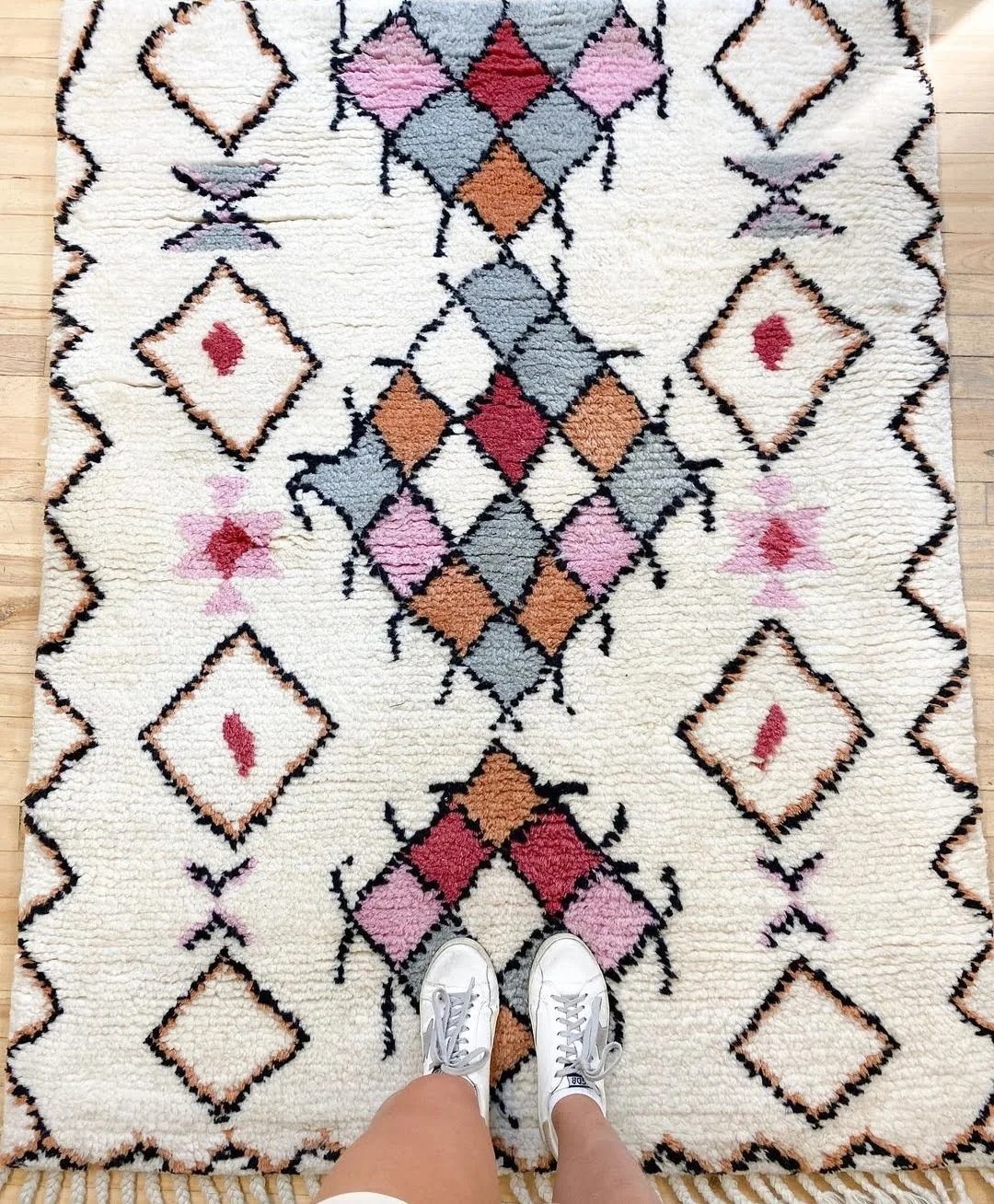
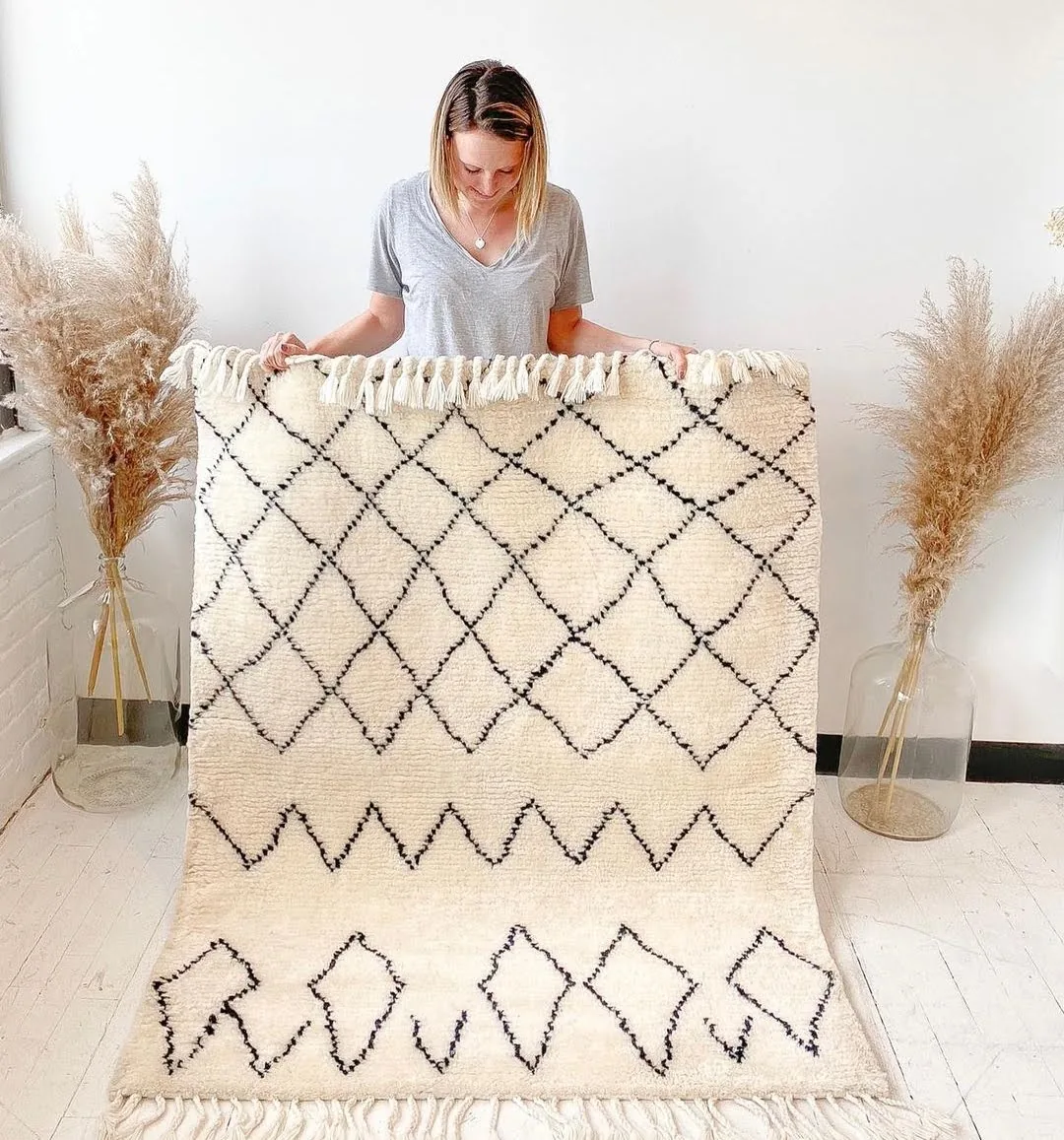
Original design to your brief. Tell us the market, palette and feeling, and our design team develops original artwork for your brand.
Interpretation from reference. Send imagery that captures what you are after and we develop something original from it.
Private label manufacturing
PiHue Creations produces under private label to client specification — your labels, your packaging, your brand. Client identity stays confidential; buyers value confidentiality, so their names stay off our pages. Read the private label programme page for how OEM programmes are structured.


Ordering, terms and shipping
Six steps from first enquiry to shipment.
- Quotation against specification — same working day.
- CAD drawing and colour proposal — 3–5 days.
- Lab dips for colour approval — 10 days.
- Physical strike-off sample — 10–15 days.
- Bulk production — 30–90 days, by construction.
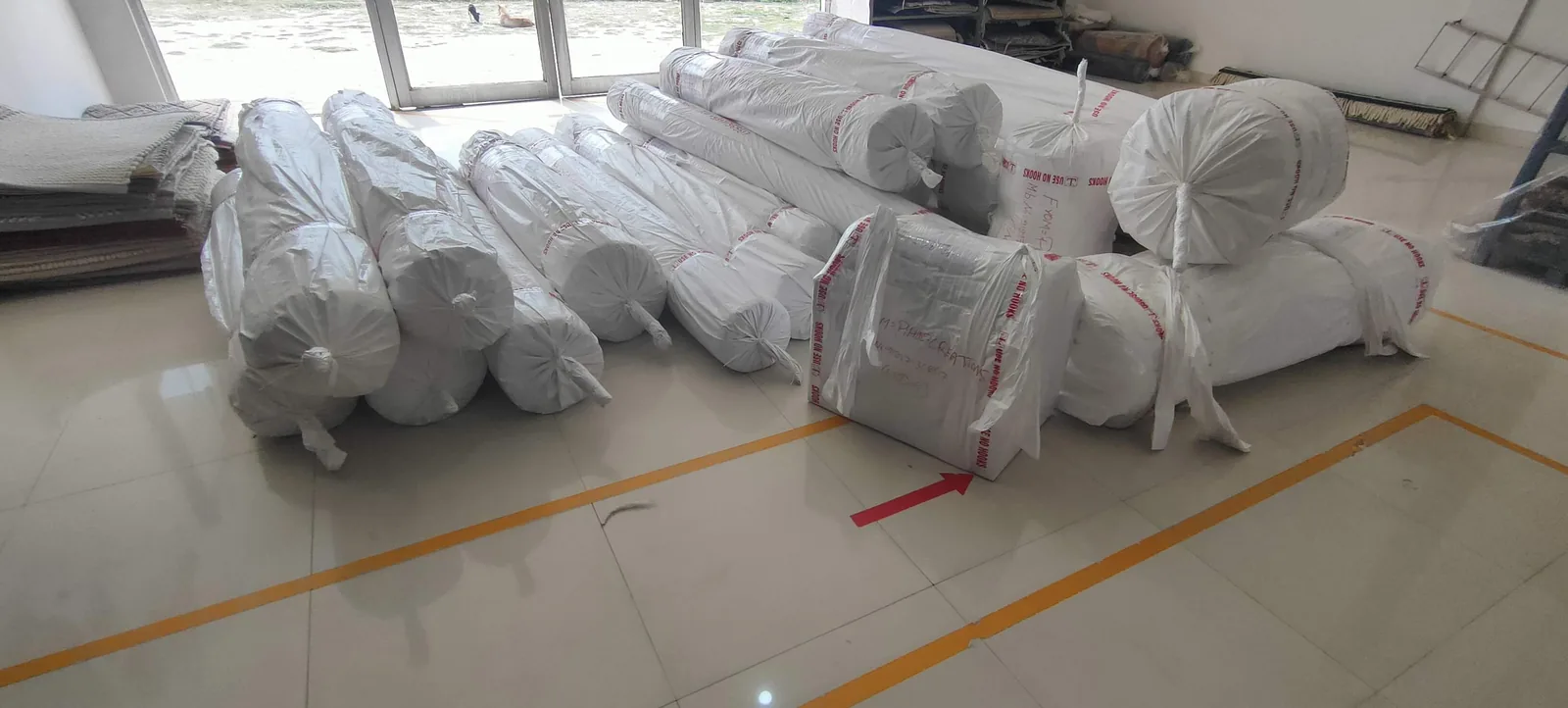
- Finishing, inspection and packing — 5–7 days.
Sample charges are quoted per project.
Commercial terms
| Term | Value |
|---|---|
| Minimum order quantity | One piece. For repeat designs in a custom colour, 10 sqm per design per colour. |
| Minimum dye lot | 1 kg |
| Size tolerance | ±3% |
| Sampling | ~15 days from CAD approval to strike-off in hand |
| Incoterms | FOB Nhava Sheva as standard; all Incoterms accepted |
| Sea / Air freight | Nhava Sheva (Mumbai) · IGI Delhi |
| Payment | 30% advance with the order, 70% against pre-shipment documents. Single pieces and bulk alike. |
| Inspection | Client or third-party pre-shipment inspection welcomed |
What we will not do
PiHue Creations declines work where we can see a problem coming for the client — a construction that will not survive its intended use, a specification that will not hold its shape, a price that can only be met by cutting something that matters. We would rather lose the order than deliver a rug that becomes someone's problem in eighteen months.
If we cannot meet a quality target or a price, we say so at the first email rather than at the third round of sampling. This is unusual in the industry, and it is deliberate — every long-standing programme we run started with a client who valued that answer.
Frequently asked questions
What is your minimum order quantity for custom rugs?
Our MOQ is one piece. We accept single-piece custom orders across every construction, fibre and size, run on the same floor and to the same standard as bulk. For repeat designs in a custom colour, the MOQ shifts to 10 sqm per design per colour.
What GSM do you manufacture hand-tufted rugs at?
Wool hand-tufted rugs run 2000 to 3500 GSM as our standard range, with pile heights from 8 to 18 mm. Silk and viscose hand-tufted pieces go higher on GSM. GSM is verified on every finished piece before packing.
What knot counts are available for hand-knotted rugs?
Knot density is specified per design, from 20 KPSI up to 150 KPSI in wool and 180 KPSI in pure silk. Lead time steps with knot density, from 35 days at the open end to 130 days at 180 KPSI in pure silk. Higher counts allow finer design detail and denser pile.
How long does a custom rug take to manufacture?
Timing runs from strike-off approval, which typically sits 15 days after CAD approval and lab dip. Handloom 30–60 days (30 on urgent orders), flatweave 35–45 days, hand-tufted 35–45 days, and hand-knotted lead time steps with knot density — 35 days at 20-30 KPSI, 60 days at 30-60 KPSI, 90-100 days at 60-100 KPSI, and 130 days at 100-180 KPSI. Mixed orders track the slowest construction in the set.
What is the largest rug you can weave without a seam?
Our maximum loom width is 20 ft. Lobby, ballroom and banquet-scale pieces up to that width are woven whole, without a seam. For pieces above 20 ft in the shortest dimension we discuss the project on its specifics — some designs join well, others do not.
What is the largest rug you can make without a seam?
Hand-tufted, 30 ft × 150 ft on the frame. Woven, 20 ft in width. Tufted goes larger because the design is traced onto backing rather than woven across a loom, so the frame can be built much bigger than a weaver can reach across.
Can you make a carpet for a hotel ballroom?
Yes. A 30 × 80 ft hall carpet is one continuous tufted piece. Largest delivered is 60 × 180 ft, planned in sections from a full-size traced design, single dye lot, laid out and inspected complete before dispatch.
Why are woven rugs limited to 20 feet but tufted rugs are not?
A loom is only as wide as the weavers can reach across — and beat the weft consistently across, for weeks. A tufting frame carries a full-size traced drawing rather than a loom of yarn, so it can be built much larger. Our frames run to 30 ft wide and 150 ft long.
How do you match colour across carpet sections?
Single dye lot across every section in the order. Minimum dye lot is 1 kg, so matching holds even on small repeat sections. Density and pile height are matched section to section and the complete carpet is laid out whole and inspected before dispatch.
What is your minimum dye lot?
Our minimum dye lot is 1 kg. That puts a custom colourway on a single rug, not only on a bulk programme. A client can develop a full palette at sample stage without committing to a dye batch — very few factories in India will do this because 1 kg lots are commercially inefficient.
Do you offer private label manufacturing?
Yes. We produce under private label to client specification — your labels, your packaging, your brand. Client identity stays confidential and artwork remains the client's property; we confirm that in writing before any design changes hands.
Which certifications do you hold?
Six certifications: GoodWeave (child-labour-free supply chain), RWS (Responsible Wool Standard), GRS (Global Recycled Standard), OEKO-TEX Standard 100 (materials tested for harmful substances), ISO 9001:2015 (quality management system), and SMETA / Sedex (four-pillar social audit). Every certification is independently verifiable with the awarding body.
How are handmade rugs manufactured?
Every rug on our floor moves through twelve stages: yarn intake and testing; shade card and lab dips; dyeing (at a contracted OEKO-TEX and RWS certified plant); drying; spinning; work order (folio); yarn issue and accountability; weaving on the loom; receiving (bazar); clipping, carving and finishing; washing and drying; final QC, packing and documentation. Verification is built into the flow.
How do you verify GSM on every rug?
GSM is calculated and verified on every single piece as it comes off the loom — not sampled, every piece. Measured on a calibrated analytical balance (calibrated by IICT Bhadohi) against the specified GSM on the work order. See the journal post how we verify GSM on every rug for the exact method.
How is yarn consumption tracked in rug manufacturing?
Each rug or batch is issued as a work order (folio) carrying the yarn requirement per square metre. Yarn is issued from the store against that requirement; consumption is reconciled on return; any shortage carries forward against the next issue. Nothing leaves the store unaccounted.
What is a lab dip and how long does it take?
A lab dip is a small dyeing of yarn matched to a reference colour (Pantone, ARS 1400 or a physical swatch), returned to the buyer for approval before bulk dyeing. Our lab dips are returned in about ten days. Minimum dye lot is 1 kg, so custom colours are available on a single rug.
Can you manufacture rugs under our own brand?
Yes. PiHue Creations manufactures under private label — your labels, your packaging, your brand. Client identity stays confidential; artwork remains the client's property; we confirm that in writing before anything is sent.
Send us your design. Quotation within hours.
A CAD, a sketch or a reference photo is enough — we return pricing, material options and a sampling plan the same working day.
Prefer a document to circulate internally? Download the capability profile (PDF). Ungated — no form.