Silk
An unlikely beginning
Mulberry silkworms spend their short lives eating mulberry leaf, then spin themselves a cocoon from a single continuous filament — often more than five hundred metres long. That one thread, finer than hair and stronger than steel of the same weight, is the raw material.

Unwinding a single thread
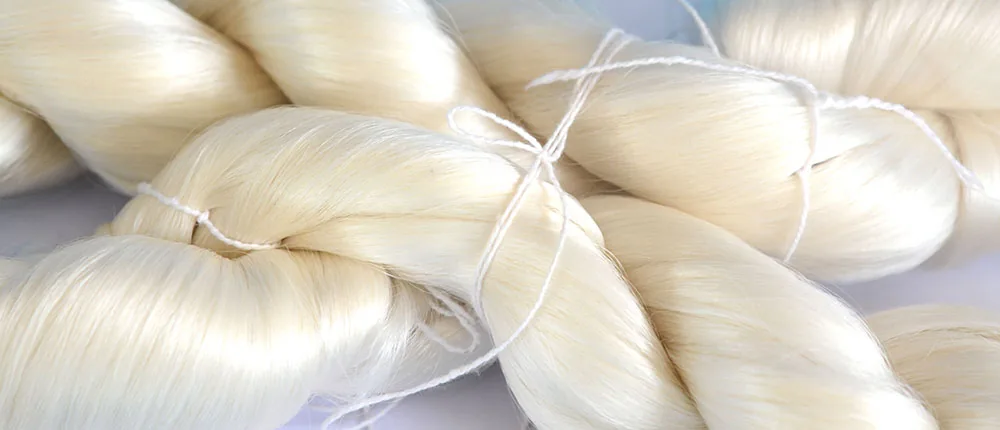
Cocoons are softened in warm water and their filaments unwound — reeled — several together, since one alone is too fine to handle. The reeled strands are thrown (twisted) into workable silk yarn with the high, liquid sheen nothing else in nature has.
Where silk goes in a rug
Silk takes dye more brilliantly than any other rug fibre — the same madder red reads deeper, the same indigo reads darker. In our rugs it appears as highlights knotted into a wool field, tracing a motif so it catches light as you cross the room, or as all-silk accent pieces for low-traffic settings.

Light in motion
A silk-accented rug changes with the hour: matte from one door, luminous from the other. That direction-dependent shimmer is the whole point — and the reason photographs never quite do a silk rug justice.

- MULBERRY SILK
- REELED FILAMENT
- ACCENT OR ALL-SILK
- LOW-TRAFFIC ADVISED