
Every claim we make about a rug can be verified.
What we test, how, who audits it, and what the buyer receives. Six pages covering the routine in-house checks, the routine third-party tests, and the tests we arrange per project on request.
What PiHue tests, to which standards, at which labs
Every claim we make about a rug can be verified. This section is how — the tests PiHue routinely performs, the tests we arrange per project on request, the standards each test is scored against, and the labs and institutes we work with. Each page below covers one measurement or one boundary; every technical figure sits on a citation you can check.
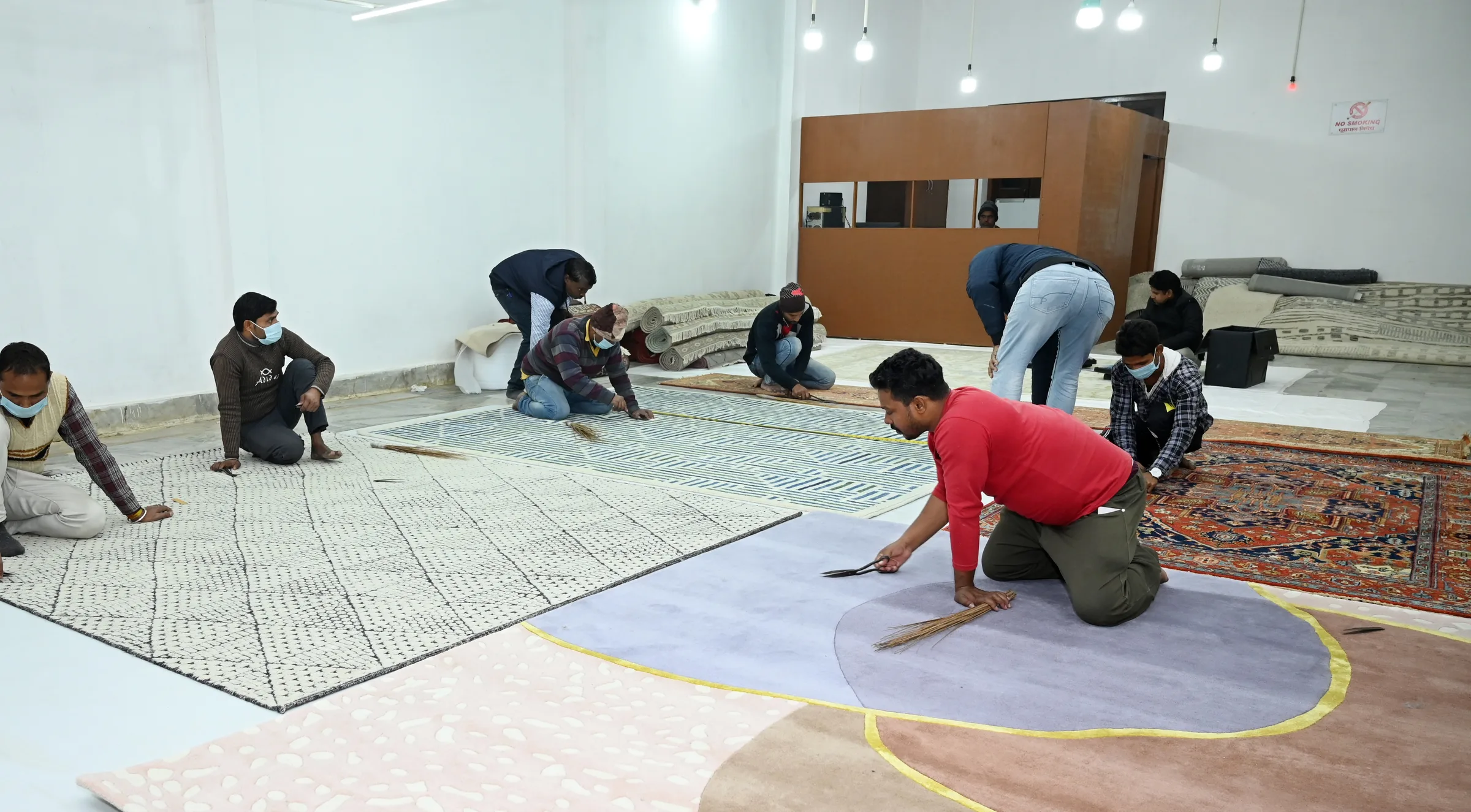
Two things separate this section from most factory-testing pages: nothing is claimed as routine that we arrange on request, and every third-party lab is named — the institute, the country and the standard.
Six pages
- GSM measurement — whole-rug weight divided by measured area, per piece before packing, with a ±5% GSM tolerance committed in writing on the PO. A piece outside tolerance is rejected and remade, not shipped.
- Chemical testing — Oeko-Tex Standard 100 certified through Hohenstein, Germany, plus a monthly random Chem-ST restricted-substances panel run at Eurofins Product Testing India in Gurgaon. Thirty-one parameter groups, essentially all Not Detected, with pH results published.
- Calibration and lab partners — the weighing scale is calibrated every three months through IICT Bhadohi (the Indian Institute of Carpet Technology, in the same town as our factory). IICT also runs our wool content and hexapod testing. Hohenstein, Eurofins, Intertek and SGS complete the third-party bench.
- Size and dimensional tolerance — length and width measured on every rug against the SKU and the approved CAD, with a size tolerance of ±3%. Skew is checked on every rug at a tolerance of no more than 1 inch — a specification most competitors do not publish.
- Scope — what we test, what we arrange — the honest boundary. What is routine and per-piece in-house, what is routine third-party (Oeko-Tex, monthly Eurofins panel), and what is arranged per project on request.
- Standards explained — the reference sheet: what ISO 105-X12, ASTM E648, EN 13501, Oeko-Tex Standard 100, REACH SVHC and the rest actually measure, who issues each, and what the classification bands mean. Nothing here claims PiHue performs any specific standard; the page is definitional.
Why we structured the section this way
A test is a claim about a rug. A published test method is a claim about a factory. The two collapse together on most manufacturer sites into a "we test to X" line that could mean anything from an in-house per-piece protocol to a one-off report a buyer paid for years ago. That collapse is the problem this section is designed to fix.
Every page names the boundary: what we do on every piece, what we do routinely as a batch check, and what a buyer pays for us to arrange when a project needs it. If a page doesn't say how often something is tested, assume it is on request. Nothing is buried.
The differentiators
Three things on this section a buyer will not find elsewhere in the industry with the same specificity:
- A written ±5% GSM tolerance in the purchase order, with rejection and remake as the remediation — not rework, not discount.
- A skew tolerance published as a spec: not more than 1 inch on every rug.
- Named institutes for chemical testing: Oeko-Tex Standard 100 via Hohenstein in Germany, restricted-substances panel via Eurofins Gurgaon, calibration via IICT Bhadohi. Named, in each case; not "an accredited lab".
How to use this section
If you are new to rug sourcing, read the scope page first — it settles what is routine before every other page describes it in detail. If you are a designer or a compliance team looking up a specific standard, jump to standards explained. If you are here for a specific measurement, the six-page list above is ordered by how directly each covers your question.
Frequently asked
Which tests does PiHue perform routinely?
In-house per piece: GSM, size (length and width against the SKU and the approved CAD), skew, and net and gross weight. Routine third-party: Oeko-Tex Standard 100 through Hohenstein in Germany, and a monthly random Chem-ST restricted-substances panel at Eurofins Product Testing India in Gurgaon. Wool content and hexapod testing through IICT Bhadohi.
Which tests are on request rather than routine?
California Proposition 65 clearance and REACH SVHC statements through Eurofins on request. Colourfastness, tensile, tear, abrasion, flammability and VOC through Intertek or SGS on a per-project basis. Fire testing (ASTM E648, IMO 2010 FTP Code Part 2, EN 13501) is always project-specific — PiHue holds no blanket fire certification.
Where can I see the test reports?
Test reports are available to buyers on request. The most recent chemical panel is available with sample details redacted; the Oeko-Tex Standard 100 certificate is shared during buyer onboarding along with the IICT calibration record and shipment-level QC slips.
Do you offer GOTS-certified production?
No. Partial GOTS parameters are included in the restricted-substances panel we run monthly at Eurofins, but PiHue is not GOTS-certified and does not claim GOTS certification on any programme.
Send us your design. Quotation within hours.
A CAD, a sketch or a reference photo is enough — we return pricing, material options and a sampling plan the same working day.