
Journal · Manufacturing ·
Ninety days, stage by stage.
A custom handmade rug is a ninety-ish-day arc, from CAD approval to dispatch, with every stage carrying a published duration. This post walks through every stage with the figures we actually commit on the pro-forma, and shows what the floor looks like at each one. For a hand-knotted rug at 150 KPSI the arc stretches further; for a flatweave it compresses. Here is the shape, honestly.
Day 0 — enquiry to quotation
A quotation is returned the same working day on a confirmed brief. The quotation lists construction options, lead time against the chosen density (where applicable), fibre, GSM, size, Incoterms and a sampling plan. MOQ is 1 piece on every construction. If the brief is ambiguous we ask one or two clarifying questions and quote within hours; if the brief carries a CAD, a sketch, a photograph or a sketch-and-dimensions, we quote against the file.
Days 1–10 — lab dip per colourway

Lab dips take about ten days per colourway. The reference is Pantone TPX, Pantone TCX or ARS 1400, matched by our dye masters in wool and sent to the buyer for approval under D65 light. We do not skip the light-box check, and we do not pull a colour into production until the dip is signed off against the physical submission.
Days 1–15 — CAD redraw and strike-off

Running in parallel with the lab dip, our studio redraws the CAD onto the construction’s grid: knot map for hand-knotted, back-marked grid for hand-tufted, warp count for handloom, pick sequence for flatweave. The redraw file is proofed back to the buyer; we do not weave from a file the buyer has not seen. A physical strike-off (a sample of the final rug, woven at scale) follows about fifteen days after CAD approval. The strike-off is the sign-off moment: once approved, production begins.
Days 15–45 (flatweave or handloom) / 15–60 (hand-tufted) / 15–105 (hand-knotted) — loom time
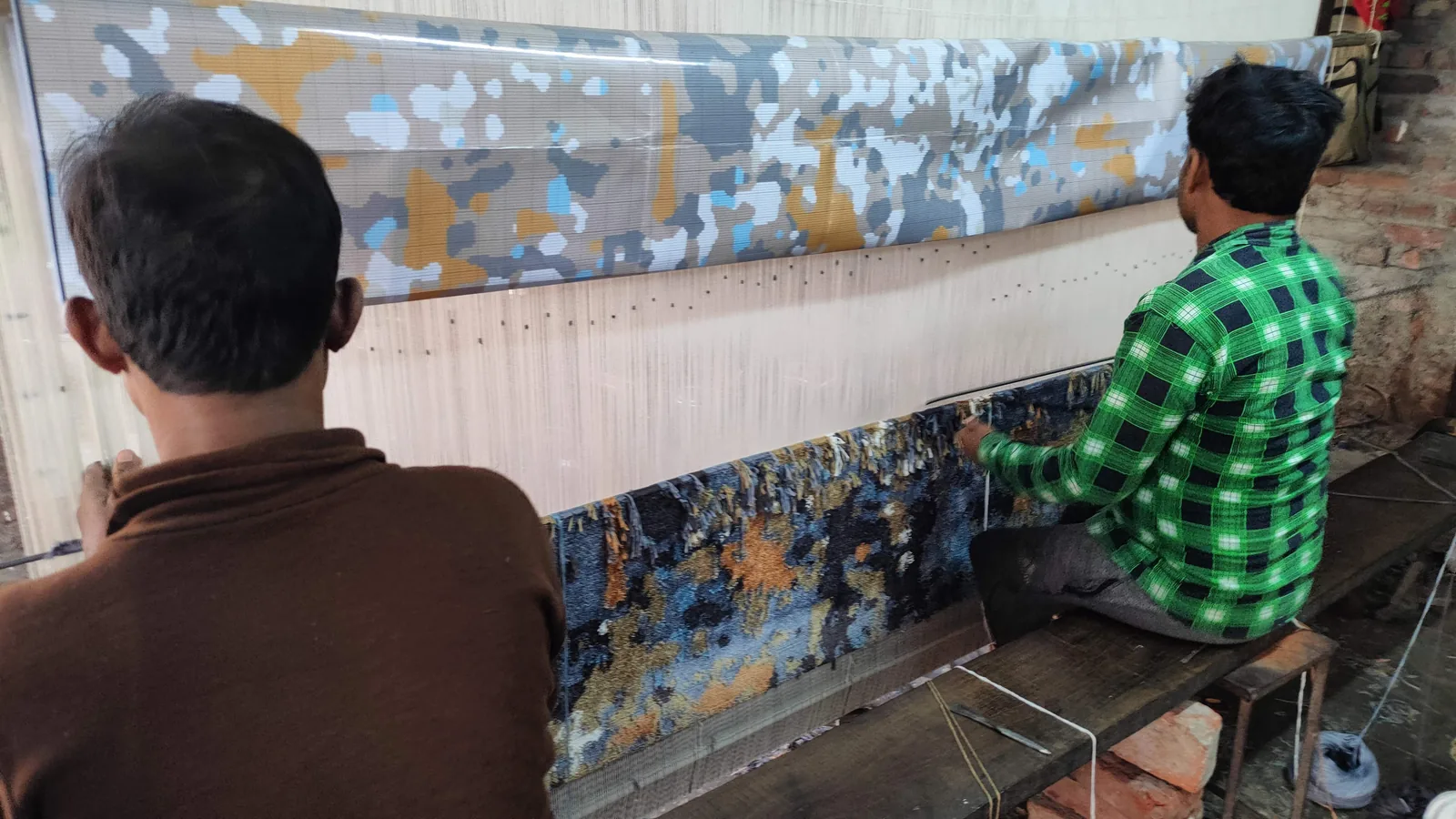
Loom time depends entirely on the construction and density. Handloom takes 30 days. Flatweave takes 35 days. Hand-tufted takes 35–45 days depending on GSM and carved relief. Hand-knotted takes 45 days at 30 KPSI and 90 days at 150 KPSI, scaled linearly between. This is the single longest stage in the production arc; the rest of the arc wraps around it.
On a mixed order across several designs or constructions, the lead time typically tracks the slowest construction in the set rather than summing. We quote the mixed-order lead time against the specific designs on the pro-forma, not against a generic figure.
After loom-off — receiving and bazar check
The rug comes off the loom and into receiving. Every piece carries an ID assigned at off-loom, traceable in the ERP from this point forward. The bazar check is the first full-pile inspection against the specification: GSM is roughly weighed, size is checked against the SKU, and any gross defects are flagged for rework before the piece moves to washing.
Washing
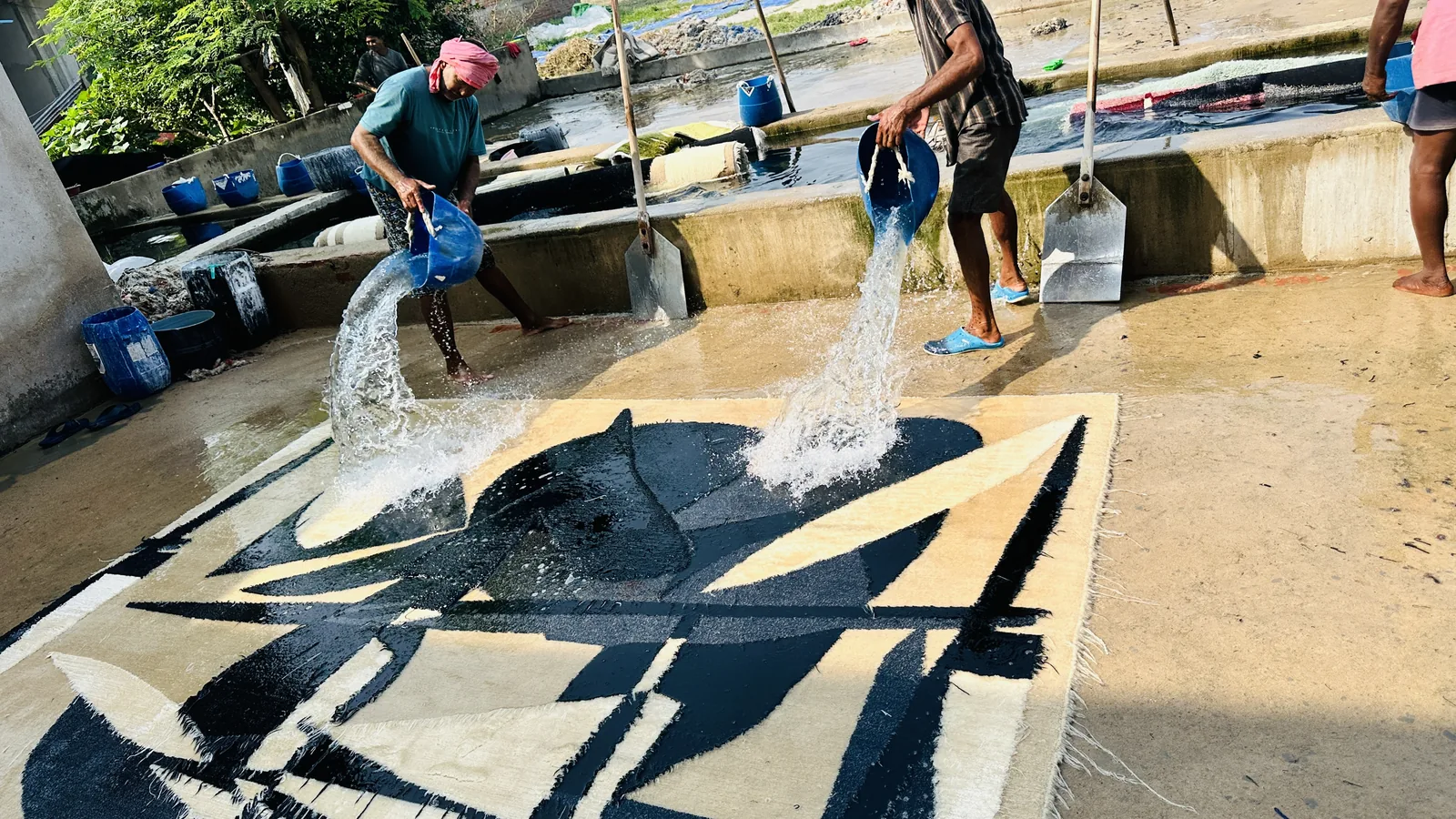
Washing is where water opens the pile and sets the wool’s natural lustre. The rug is laid flat on the washing floor, washed, rinsed to pH-neutral, and moved to drying. Dye bleed, if any has not been caught at wash-fastness testing, shows up here — it is the last place to catch a problem before stretching.
Drying and stretching

Drying is done flat under tension. The tension is what trues the edges and sets the length and width to the SKU; a rug that leaves drying unbuckled is a rug that will lie flat on the client’s floor. Any shape correction a buyer requested at specification is held through this stage.
Carving (if specified)

If the design calls for carved relief, this is the stage where the pile is sculpted. Every carved edge at PiHue is cut by hand with long-blade shears. Machine bevelling exists in the industry and reads the same on every rug it touches; hand carving does not, and the texture is deliberate.
Final QC — GSM, size, skew
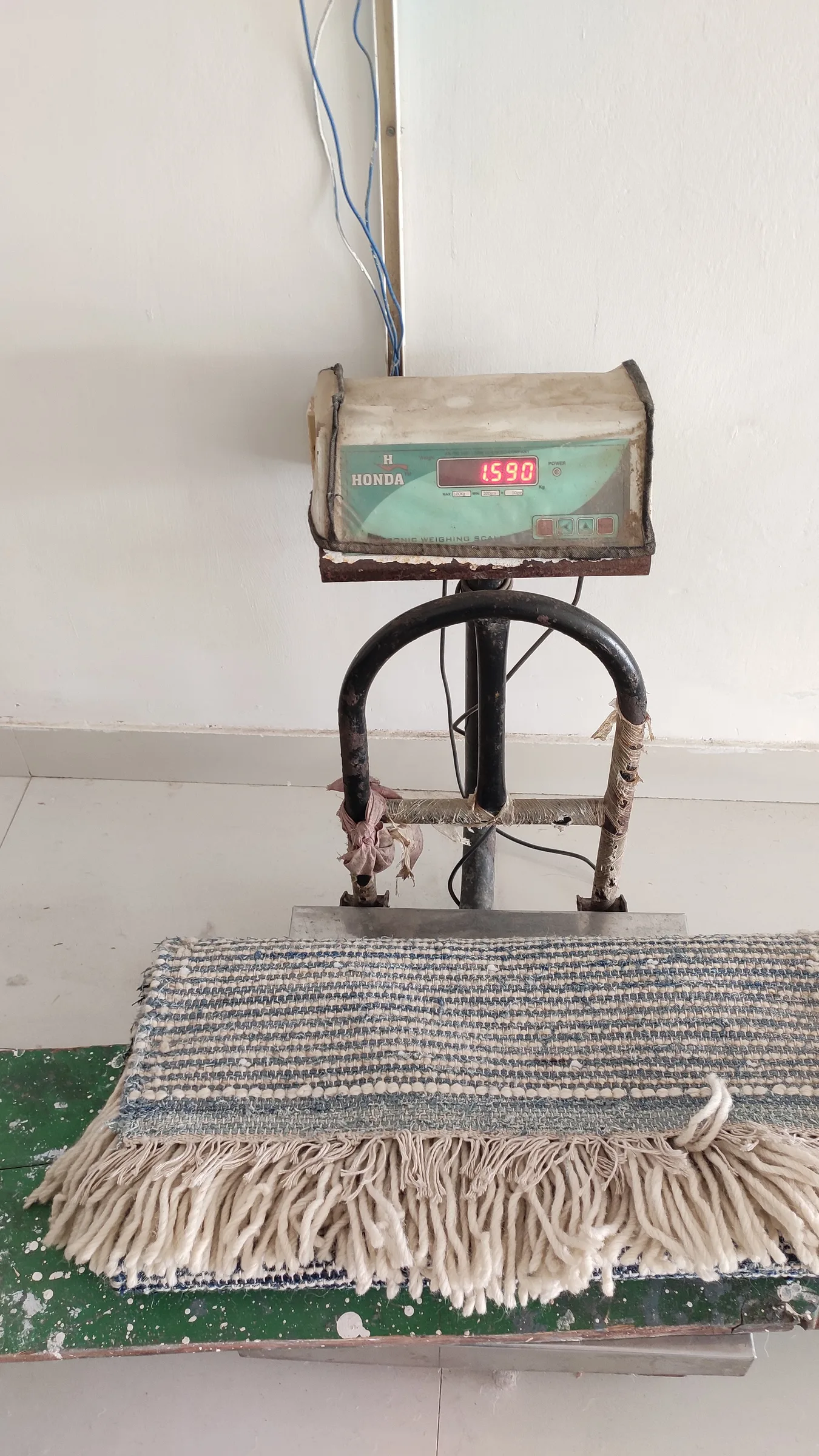
Final QC is where the three published tolerances are verified. The whole rug is weighed on a calibrated digital scale (10 g accuracy; calibrated every three months at IICT Bhadohi) and the weight is divided by the measured area to give the GSM. If the GSM is outside the ±5% tolerance committed in writing on the PO, the piece is rejected and a new piece is made for the client — not reworked, not discounted, not shipped. Length and width are checked against the SKU and the approved CAD for the ±3% size tolerance. Skew is checked on every rug; not more than 1 inch.
Labelling, packing, dispatch
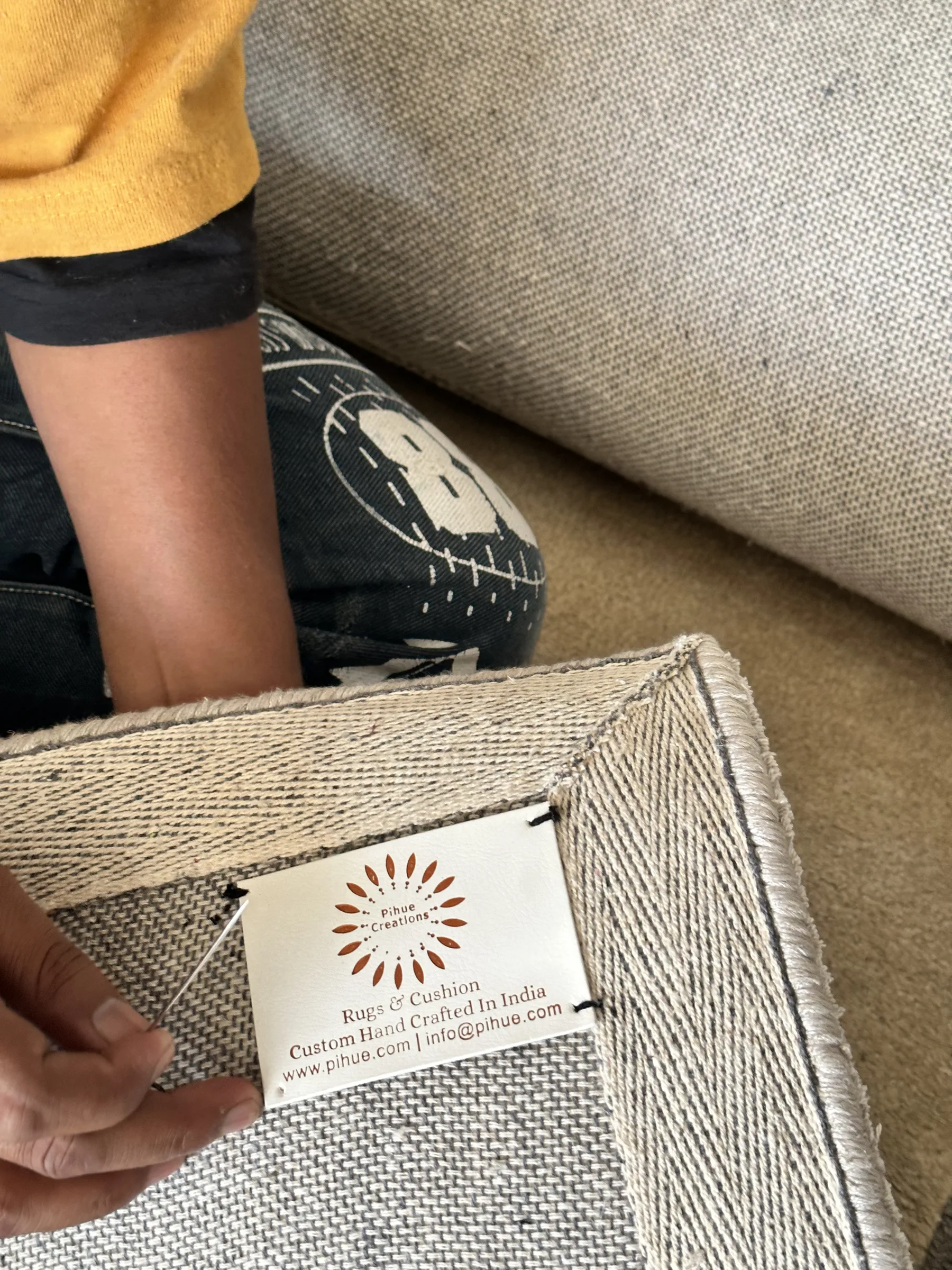
The rug is labelled with the buyer’s mark on private-label programmes, the appropriate certification marks are stitched alongside, barcoded if the buyer uses barcode receiving, rolled, and wrapped in moisture-resistant LDPE. The pre-shipment inspection photographs, the GSM reading on the QC slip, and the transaction certificates for GoodWeave, RWS and GRS (where applicable) travel with the pro-forma.

Pricing basis is FOB Nhava Sheva (Mumbai) for sea freight and FOB IGI Delhi for air. Freight is buyer-nominated, buyer’s own courier account, or PiHue-arranged and added to the invoice. Payment is 50% advance and 50% before dispatch; goods do not leave until paid in full.
What goes wrong on the ninety-day arc
- Late CAD approval compresses the strike-off window. If the buyer takes a week to approve the redraw file, the strike-off slips and the loom start slips with it. We hold the loom slot against the pro-forma date; a week late at CAD means a week late at loom-start.
- Lab dip approved on screen rather than against the physical dip. Screen approval is not sufficient; the surprise moment happens at receiving. The dip is sent for physical sign-off under D65 light.
- Changing the fibre after strike-off. Dye recipes are matched to a fibre; a wool-to-wool-viscose swap after strike-off means re-approving the dips. Fibre is on the pro-forma for a reason.
- Mixed orders expected to finish faster than the slowest construction. They do not. A mixed hand-knotted and hand-tufted programme ships when the hand-knotted finishes.
- No pre-shipment inspection photographs requested. The photographs settle most warranty conversations before they start. The pack is standard; request it on the pro-forma and it ships with the invoice.
Further reading on this site
Deeper on each stage: lab dip process, reading a knot map, how we verify GSM on every rug. On construction and lead time trade-offs: construction comparison. On the full specification baseline: specifications, testing & measurement, certifications.
Frequently asked
How long does a custom rug take from CAD approval to dispatch?
The arc from CAD approval to dispatch runs about 90 days for a typical hand-tufted or carved hand-tufted programme. Handloom is faster at about 30 days of loom time. Flatweave is about 35 days. Hand-knotted scales with density — 45 days at 30 KPSI and 90 days at 150 KPSI — and the strike-off, wash, finish, QC and pack stages wrap around that loom window.
How long is the lab-dip stage?
About ten days per colourway. The reference is Pantone TPX, Pantone TCX or ARS 1400, matched by our dye masters in wool and sent for physical approval under D65 light. We do not skip the light-box check and we do not pull a colour into production until the dip is signed off against the physical submission.
What happens if a finished rug is outside the GSM tolerance?
If the GSM is outside the ±5% tolerance committed in writing on the PO, the piece is rejected and a new piece is made for the client. Not reworked, not discounted, not shipped. The tolerance is contractual, not an internal working figure, and the digital scale is calibrated every three months through IICT Bhadohi.
Why is lead time scaled linearly for hand-knotted?
Because density is physical. A hand-knotted rug at 30 KPSI holds about ten times fewer knots per square inch than one at 300 KPSI, and each knot is tied by a weaver by hand. Doubling the density roughly doubles the labour time. 45 days at 30 KPSI and 90 days at 150 KPSI is the published arc, scaled linearly between.
What ships with the rug when it dispatches?
A pre-shipment inspection photograph set per rolled rug with the GSM reading on the QC slip, the transaction certificates for GoodWeave, RWS and GRS (where applicable), the commercial invoice and packing list, HS classification, certificate of origin, Oeko-Tex Standard 100 licence details on request, the most recent Chem-ST panel report on request, and the REX number for every EU shipment.
Can we visit during the production arc?
Yes. Hotel procurement teams, brand design teams and interior designers visit regularly, usually around the strike-off or final-QC stages. We book the visit against the production calendar so the stages you want to see are on the floor when you are.