
Flat, reversible, all pattern — the interlocked-slit weave.
Kilim is a flatweave tradition in which the design lives in the weave itself. PiHue weaves kilims on vertical looms in the interlocked-slit technique that has travelled from Anatolia to Bhadohi and back for centuries.
What is a kilim rug?
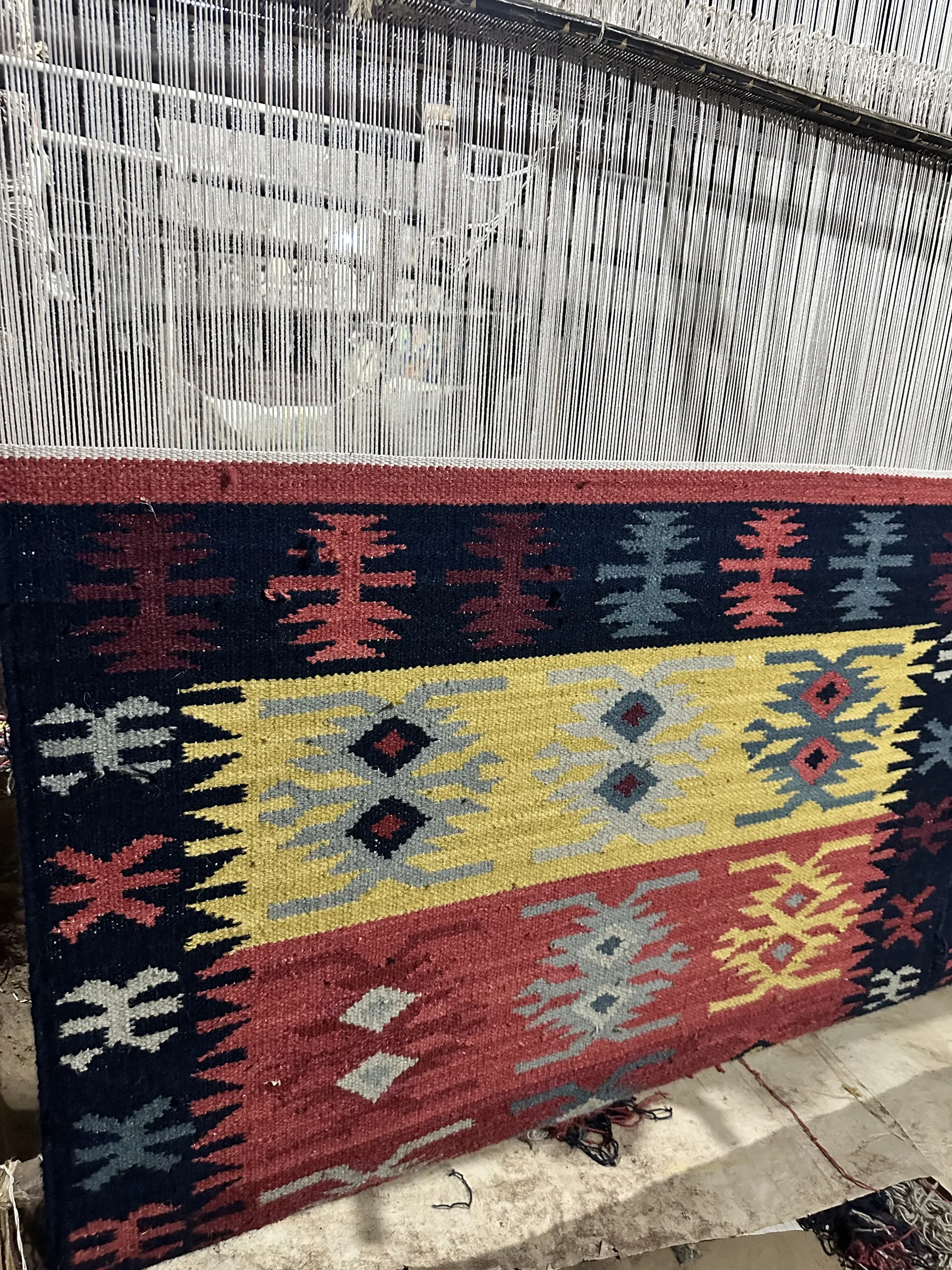
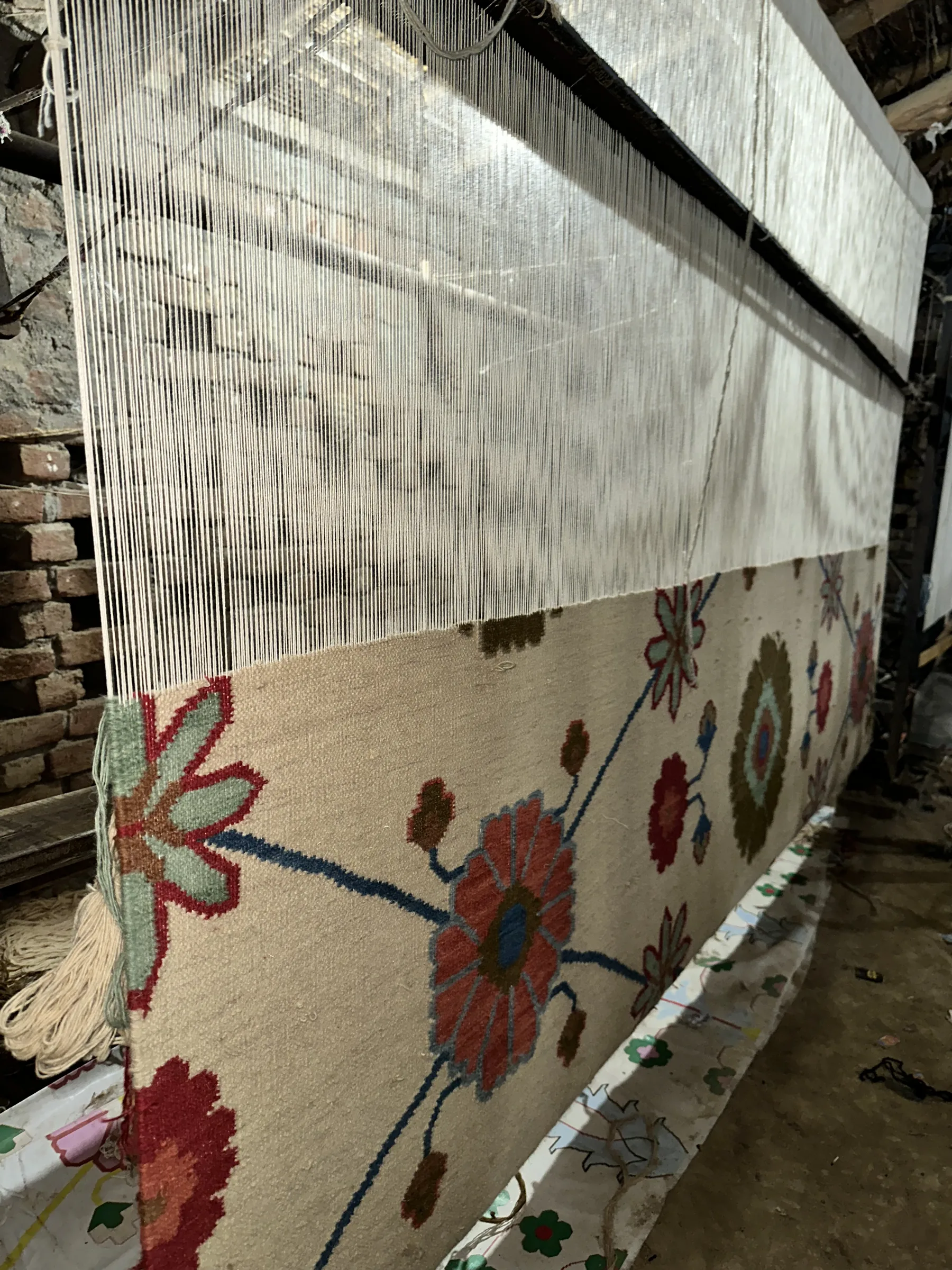
A kilim is a flatweave rug in which the design is built entirely by the interlacing of dyed weft yarns across a stretched warp — no pile, no knots, the pattern living in the weave itself. PiHue weaves kilims on vertical looms in Bhadohi in the traditional interlocked-slit technique that has been used across the trade routes from Anatolia to Bhadohi for centuries, and the technique is what gives kilims their characteristic sharp geometric motifs and reversible flat surface.
How is a kilim different from a dhurrie or a handloom rug?
A dhurrie is the umbrella term used in the Indian trade for a flatweave rug and covers a broad range of techniques, of which kilim is one specific tradition characterised by geometric motifs and interlocked-slit weaves. A handloom rug is loomed on a pedal-operated wide handloom and is typically a plain-field construction with texture rather than pattern — there are no interlocked-slit motifs on a handloom rug. A kilim is neither of those; it is a specific style within the flatweave family.
The three ways to tell them apart on a finished rug: a kilim has small vertical slits between colour blocks where the weft yarns interlock (visible on the reverse), a dhurrie may or may not; a handloom rug has a repeating ribbed texture and no distinct motif; and both dhurries and handloom rugs are typically loomed at commercial widths while a kilim is often woven at guest-room size on a smaller vertical loom.
What sizes and materials do PiHue kilims come in?
PiHue weaves kilims in wool, cotton, and jute (see wool, cotton, jute), and typically at sizes between 4×6 ft and 12×18 ft. Larger runners and custom sizes are quoted on request. The size tolerance for a finished kilim is ±3% and skew is checked at not more than 1 inch on every piece, per the standard PiHue QC pack — see size and dimensional tolerance.
Why choose a kilim?
A kilim is the right answer when the buyer wants pattern without pile — a rug that lays flat, is fully reversible, weighs less than a knotted or tufted equivalent of the same size, and reads as textile rather than as carpet. Kilims work well under a dining table where a low pile stops chairs catching, in a foyer where a lightweight floor covering is easier to lift and shake out, and in warmer climates where a heavy pile rug can feel oppressive. They also age visibly — a kilim shows its history in a way pile rugs do not, and that is often the point.
Is a kilim durable?
Yes, in the right setting. A wool kilim woven at a good pick density will serve decades of residential use; a jute or cotton kilim is lighter-duty and better suited to a low-traffic room or a decorative overlay. Kilims are not the right choice for very high-traffic commercial spaces where a hard-wearing tufted or knotted pile is needed — the trade-off for the flat surface is a lower resistance to concentrated wear. For hospitality contract work we recommend a knotted or tufted rug at the specified pile weight, not a kilim.
Which colours and designs are available?
Kilim design vocabulary is traditionally geometric — diamond motifs, stepped bands, medallion-and-corner layouts, and the interlocking hooks and stars carried across the trade route — and PiHue's kilim programme carries the traditional vocabulary. Contemporary abstract designs and buyer-supplied CAD work well on the same loom, and the colour range is set by what the contracted dye plant can match: PiHue colour-matches against Pantone TPX/TCX and ARS 1400 references through lab dips before production begins (see rug dyeing and our lab dip process).
How is a kilim quality-checked?
Every finished kilim is inspected on the same QC bench as every other rug PiHue ships: length and width measured on every piece against the SKU and the approved CAD, skew checked at not more than 1 inch, net and gross weight both recorded, colour compared against the approved lab dip and strike-off under standard light. The kilim-specific check on top of the standard bench: the weft density is inspected against the specified picks-per-inch and the interlock slits are inspected for consistency along the whole length. See the QC page for the full three-gate protocol.
Related pages
- Flatweave rugs — the umbrella construction, of which kilim is one style
- Handloom rugs — the pedal-loom alternative
- Wool · Cotton · Jute
- Size & dimensional tolerance
Frequently asked
What is a kilim?
A flatweave rug in which the design is built entirely by the interlacing of dyed weft yarns across a stretched warp — no pile, no knots. Characterised by geometric motifs and a reversible flat surface. Woven on vertical looms in the traditional interlocked-slit technique.
How is a kilim different from a dhurrie?
Dhurrie is the umbrella term used in the Indian trade for a flatweave rug. Kilim is one specific tradition within that family, characterised by geometric motifs and interlocked-slit weaves. A kilim always has small vertical slits between colour blocks where the weft yarns interlock; a dhurrie may or may not.
Are PiHue kilims woven in Bhadohi?
Yes. Every PiHue kilim is woven on vertical looms in our Bhadohi facility using the traditional interlocked-slit technique. Yarn is dyed at a contracted OEKO-TEX and RWS certified plant and matched via lab dips before production begins.
What sizes are available?
Typically between 4×6 ft and 12×18 ft, in wool, cotton or jute. Larger runners and custom sizes are quoted on request. The size tolerance is ±3% on every piece with skew not more than 1 inch — the standard PiHue QC pack applies.
Is a kilim durable enough for commercial use?
A wool kilim woven at good pick density serves decades of residential use. Kilims are not the right choice for very high-traffic commercial spaces — the trade-off for the flat surface is lower resistance to concentrated wear. For hospitality contract work we recommend a knotted or tufted rug at the specified pile weight.
Can PiHue weave a custom kilim design?
Yes. Traditional geometric designs and buyer-supplied CAD both work on the same loom. Colour is matched against Pantone TPX/TCX and ARS 1400 references through lab dips before production begins.
Send us your design. Quotation within hours.
A CAD, a sketch or a reference photo is enough — we return pricing, material options and a sampling plan the same working day.