
What 'ecru' really means in a rug brief: natural, greige, undyed
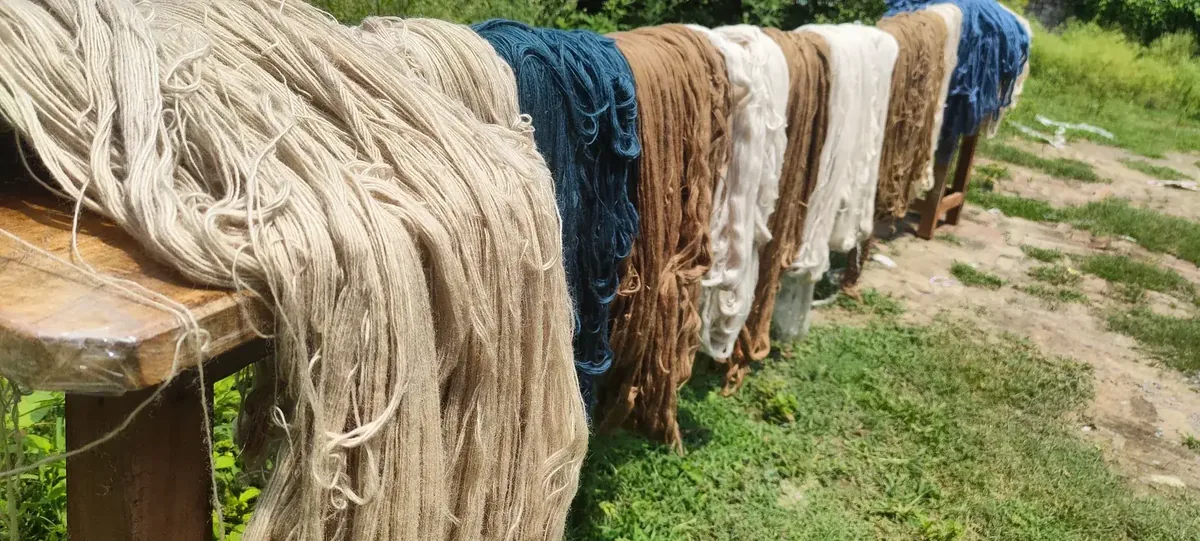
“Can you do an ecru rug?” is one of the most forgiving questions in our enquiry inbox, and one of the easiest to answer wrong. The brief sounds like a colour instruction. It is actually a stack of four smaller questions — and we have to settle all four before the loom starts, or the first sample comes back a different pale neutral to the one the buyer had in mind.
This is the piece we would like to send back when the question arrives, so the next buyer can read it before the call.
Four words that get used interchangeably, and shouldn't
In a loose room-brief the four terms are interchangeable; in a specification they are not. We ask buyers to pick a lane because each has a different cost, lead time and ageing behaviour.
- Natural. The yarn has not been dyed. The rug carries the native colour of the fleece, plus the residual lanolin that gives natural wool its hand. Shade varies hank to hank; we blend across spin lots to keep the range tight, but a natural rug is never perfectly uniform.
- Greige. The rug has not been finished — raw off the loom, unwashed, unsheared. This is a stage description, not a colour one. A greige rug can be any colour. “Greige” also gets used loosely to describe the pale, warm neutral of unfinished wool, which is where the confusion starts.
- Undyed. A synonym for natural when used of yarn. A synonym for greige when used of a rug. We prefer "natural yarn" or "greige rug" because they are more specific.
- Ecru. A colour family — a pale, warm neutral that sits between off-white and light tan. Ecru can be reached by the natural route (if the fleece is warm enough) or by a shallow dyebath (if the brief wants a locked value).
A typical ecru brief we receive combines two of these without noticing: "a natural ecru rug in bone, around 2500 GSM, repeatable across next year's drop". Bone is paler than natural wool will usually go. Repeatable across next year's drop means we need a locked recipe. The brief needs the dyebath route; the buyer thought they had asked for the undyed one. The lab dip resolves this in ten days, and we would rather have the conversation at enquiry.
What we need in a specification to weave it twice
Three documents sit under every ecru programme we run, and each one closes a question the colour reference alone cannot.
- A colour reference — a Pantone number, an ARS 1400 code, or an approved physical swatch. All three are workable; the lab dip reconciles them to one locked recipe.
- A yarn specification — fibre (New Zealand wool, Himalayan wool, cotton, jute), spin count, and whether the yarn is undyed or dyed-to-match. This is where the natural-versus-dyed decision gets committed in writing.
- A GSM target with ±5% tolerance in writing on the purchase order. We weigh every finished rug on a calibrated scale and record it on the receiving slip. Outside tolerance means a remake, not a discount. The method is in how we verify GSM on every rug.
Why pale neutrals are the hardest colour family to repeat
Mid-tones and darks are forgiving. The eye anchors against them, and small shade drifts read as texture. Pale neutrals have no anchor; the eye reads them as "the colour of nothing" and treats any drift as a mistake. Three effects compound this on an ecru rug.
Metamerism. A yarn that reads correctly under showroom light can read warmer under daylight or cooler under LED. Metamerism — the same recipe reflecting different wavelengths back to the eye under different light sources — is more visible on ecru than on any mid-tone. Our lab dip checks every candidate recipe under a daylight simulator before it reaches a buyer. On an ecru programme we never skip this step.
Fibre drift. Natural wool varies hank to hank. For a dyed-to-match ecru we blend across spin lots before the dyebath, lock a dyer, a vat and a recipe for the full order quantity, and treat any change mid-run as a new sample. For an undyed programme the only honest promise is "range", not "match": we commit to a shade band, not a single value.
Wash sensitivity. Our standard wash recipe is set for mid-tone wool at mid-GSM. For pale rugs we take water temperature and chemistry down a notch, because the hotter wash that gives a dark rug its bloom will strip the lanolin from natural wool and read the ecru a shade cooler. The adjustment is small, and it is one of the places where in-house finishing pays off — a contract wash house running one recipe for everyone cannot make it.
How the two routes age
Day one, a natural rug and a dyed-to-match ecru rug look almost identical. Year three, they do not.
Natural wool oxidises slowly; the lanolin reduces, the shade warms half a step and the hand softens. This is not damage — it is the behaviour that heirloom rugs are chosen for. A dyed-to-match ecru holds its locked value for years because the dye molecule, not the fleece, is doing the colour work. The right choice depends on whether the buyer wants a rug that reads the same across next year's drop or a rug that reads a little warmer every year.
Our quotation sheet asks this question in plain English, and the answer is often the thing that tips a brand toward one route or the other.
What to send us if you want an ecru programme quoted
A size, a quantity, and either a Pantone or a photo. If you want the natural route, say so and skip the Pantone. If you want it repeatable across future drops, we will quote the lab dip and the dyebath route. If you are not sure, send both and we will set up a sampling path that compares them side by side. Full programme details — constructions, shade range, sampling path, MOQ — are on the ecru rugs page.