
The dimensions behind the rule of thumb.
Standard sizes, room-by-room recommendations and the reasoning — so you can pick a size confidently, or brief us on a custom size that fits your space exactly.
Standard export sizes we produce
| Name | Metric | Imperial | Typical use |
|---|---|---|---|
| Doormat | 60 × 90 cm | 2 × 3 ft | Entryway |
| Scatter | 90 × 150 cm | 3 × 5 ft | Reading nook, bedside |
| Standard | 170 × 240 cm | 5.5 × 8 ft | Small living / dining |
| Large | 200 × 290 cm | 6.5 × 9.5 ft | Living room, front-legs-on |
| Extra large | 240 × 300 cm | 8 × 10 ft | Living room, all-legs-on |
| Oversized | 300 × 400 cm | 10 × 13 ft | Large living / dining |
| Runner | 80 × 240–400 cm | 2.5 × 8–13 ft | Hallway, kitchen, bedside |
| Round | 150–300 cm dia. | 5–10 ft dia. | Round table, bedroom |
Handmade means we are not limited to these. Custom sizes, ovals, irregular shapes, and pieces above 5 × 8 m are all regular work (loom permitting). Size tolerance on production is ±3%.
Living room
Decide first between all-legs-on (all furniture sits on the rug) and front-legs-on (only the front legs of the sofa and chairs sit on the rug). All-legs-on gives a defined, anchored room; front-legs-on floats a seating cluster inside a larger space. Neither is 'more correct' — they signal different things.
For a three-seater sofa and two armchairs, all-legs-on typically calls for 240 × 300 cm minimum, often 300 × 400 cm. Front-legs-on works from about 200 × 290 cm.
Dining room
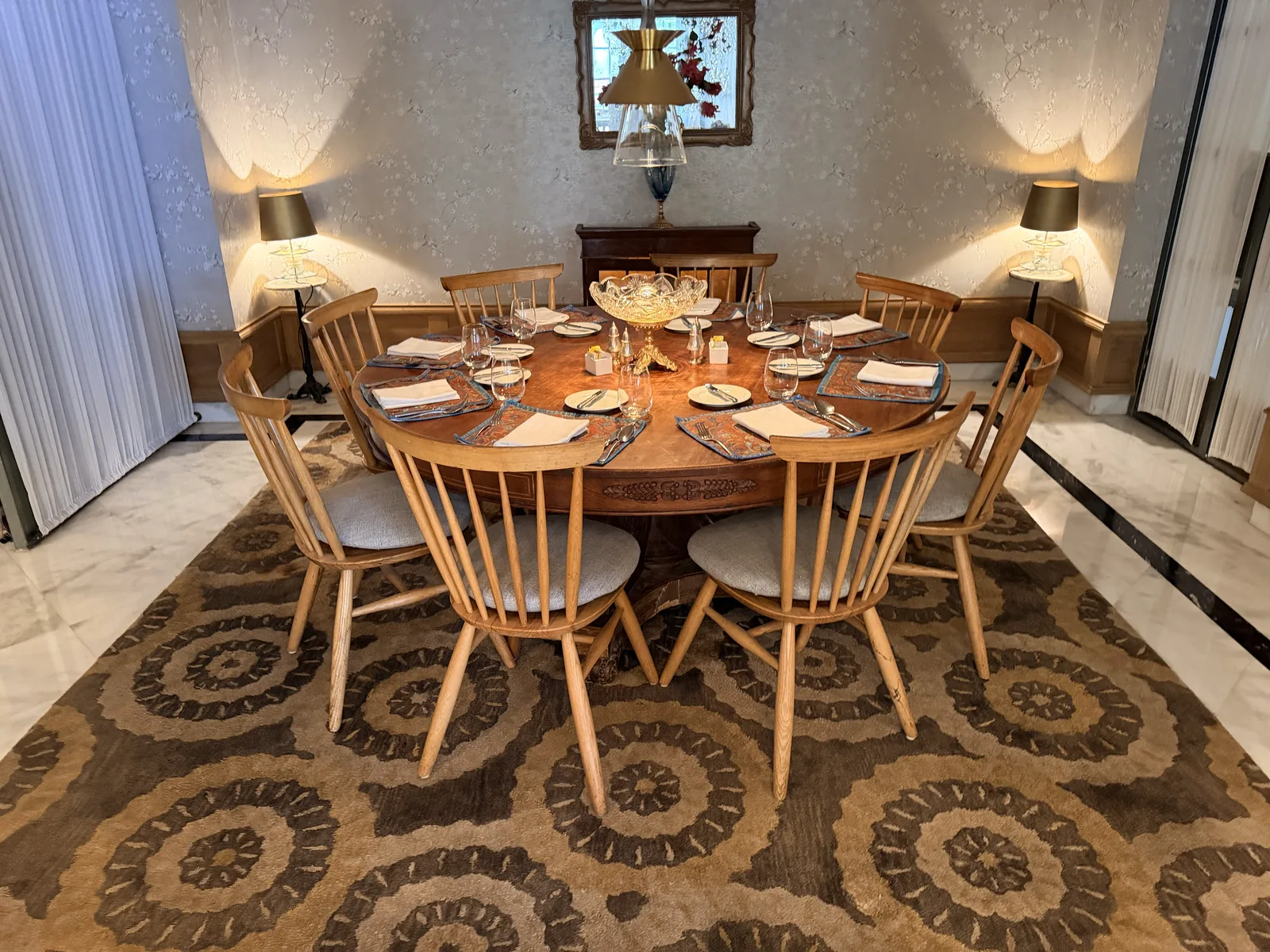
Extend the rug at least 60 cm beyond the table on every side so chairs stay on the rug when pulled out. Round tables call for round rugs.
Bedroom
Options: rug fully under the bed extending on all visible sides (about 240 × 300 cm for a king), rug from midway under the bed so feet land on rug when getting out, or two matching runners on each side of the bed. Choose based on how much of the floor you want covered.
Hallway
Runners typically 80–100 cm wide, length 30–50 cm shorter than the hallway at each end. Balanced negative space at both ends reads better than a runner that stops just short of the wall.
Frequently asked
What size rug for a living room?
The two common approaches: all-legs-on (the rug is large enough that every piece of furniture sits fully on it — usually 240 × 300 cm or 300 × 400 cm for a full sofa arrangement) or front-legs-on (front legs of the sofa and chairs on the rug — usually 200 × 290 cm or 240 × 340 cm). Both work; all-legs-on reads as a defined room, front-legs-on floats a seating cluster inside a larger space.
What size rug for a dining room?
The rug should extend at least 60 cm beyond the table on every side, so that chairs stay on the rug when pulled out. For a six-seat dining table (approx. 90 × 180 cm), that means about 210 × 300 cm. Round tables typically call for round rugs.
What size rug for a bedroom?
Three common patterns: rug fully under the bed extending 60–80 cm on the sides and foot (about 240 × 300 cm under a king bed), rug from midway under the bed (feet land on rug when getting out), or runners on each side of the bed.
What size runner for a hallway?
Runners typically 80–100 cm wide, length 30–50 cm shorter than the hallway at each end. Any longer and it looks stuffed; any shorter and it looks abandoned.
Further reading on pihue.com
Custom size for your space?
Send the room dimensions and a plan sketch. We return quotation and construction recommendation the same working day.